Testes produce sperm and testosterone, while ovaries produce eggs and estrogen.
Which gland in the male reproductive system surrounds the urethra?
B) Prostate
What part of the male urogenital tract is shared by the urinary and reproductive systems?
The urethra is shared by the urinary and reproductive systems.
Which structure is the site of sperm production?
The seminiferous tubules within the testes are the site of sperm production.
Which tube transports sperm from the ductus deferens to the prostatic urethra?
The ejaculatory duct transports sperm from the ductus deferens to the prostatic urethra.
Which structure is not a tube that transports spermatozoa?
D) Prostate
Which duct carries sperm from the epididymis to the ejaculatory duct?
The vas deferens carries sperm from the epididymis to the ejaculatory duct.
Where in the human male does spermatogenesis occur?
Spermatogenesis occurs in the seminiferous tubules within the testes.
Where do sperm mature in the male reproductive system?
B) The epididymis is where sperm mature
Where do the sperm mature and become able to swim?
Sperm mature and become able to swim in the epididymis.
What are the three functional categories of the male genital system?
The three functional categories are the testes (sperm production), the duct system (sperm transport), and the accessory glands (semen production).
Which structure does not contribute to the production of semen?
Epididymis
Which gland does not secrete fluid that nourishes the sperm? A) Seminal vesicles B) Prostate C) Bulbourethral glands D) Testes
D) Testes
What male structure is homologous to the labia majora in females?
Scrotum
Which are produced in the testes? A) Sperm and testosterone B) Seminal fluid and mucus C) Prostatic secretion and milk D) Eggs and estrogen
A) Sperm and testosterone
What does the fluid secreted from the prostate gland do?
The fluid from the prostate gland contributes to semen volume and helps to nourish and transport sperm.
What are the two tubes in the male reproductive system?
The two main tubes are the vas deferens and the urethra.
Which organ transports sperm to the urethra?
The vas deferens transports sperm to the urethra.
Which is an internal male reproductive structure? A) Vas deferens B) Testicles C) Penis D) Scrotum
A) Vas deferens
Where is semen produced?
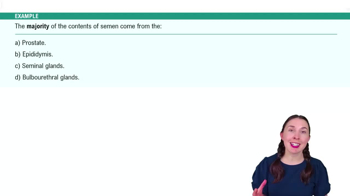
Semen is produced by the seminal vesicles, prostate gland, and bulbourethral glands.
What is the primary function of the scrotum in the male reproductive system?
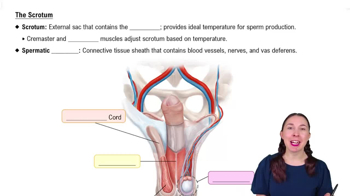
The scrotum maintains the ideal temperature for sperm production by housing the testes outside the body and adjusting their position using the cremaster and dartos muscles.
Describe the pathway sperm take from their production to maturation.
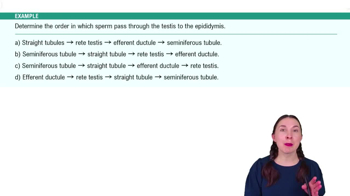
Sperm are produced in the seminiferous tubules, then move through the straight tubules, rete testis, efferent ductules, and finally enter the epididymis where they mature.
What role does the vas deferens play during ejaculation?
The vas deferens transports mature sperm from the epididymis through the pelvic cavity to the ejaculatory duct during ejaculation.
How does the bulbourethral gland contribute to the male reproductive process?
The bulbourethral gland secretes a thick mucus that lubricates the glans penis and neutralizes traces of acidic urine in the urethra before ejaculation.
Explain the difference between the corpus cavernosum and corpus spongiosum in penile anatomy.
The corpus cavernosum provides rigidity during erection by becoming engorged with blood, while the corpus spongiosum remains spongy to keep the urethra open for semen passage.
What is the spermatic cord and what structures does it contain?
The spermatic cord is a connective tissue sheath that contains blood vessels, nerves, and the vas deferens, supporting the testes and scrotum.
 Back
Back
 1:07
1:07