Skip to main content
Anatomy & Physiology
My Course
Learn
Exam Prep
AI Tutor
Study Guides
Textbook Solutions
Flashcards
Explore
Try the app
My Course
Learn
Exam Prep
AI Tutor
Study Guides
Textbook Solutions
Flashcards
Explore
Try the app
Back
Electrolyte Balance definitions
You can tap to flip the card.
Osmosis
You can tap to flip the card.
👆
Osmosis
Water movement across a selectively permeable membrane from low to high solute concentration, balancing solute levels.
Track progress
Control buttons has been changed to "navigation" mode.
1/15
Related flashcards
Related practice
Recommended videos
Electrolyte Balance quiz
Electrolyte Balance
15 Terms
Electrolyte Balance
26. Fluid and Electrolyte Balance, Acid Base Balance
7 problems
Topic
Jason
Acid-Base Balance
26. Fluid and Electrolyte Balance, Acid Base Balance
7 problems
Topic
Jason
26. Fluid and Electrolyte Balance, Acid Base Balance
3 topics
9 problems
Chapter
Jason
Guided course
07:59
Osmosis and Osmolarity
1599
views
15
rank
Terms in this set (15)
Hide definitions
Osmosis
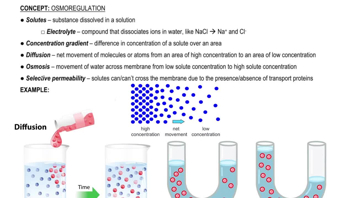
Water movement across a selectively permeable membrane from low to high solute concentration, balancing solute levels.
Diffusion
Movement of molecules or atoms from an area of high concentration to an area of low concentration, leading to even distribution.
Solute
Substance dissolved in a solution, contributing to the overall concentration and osmotic properties of the mixture.
Electrolyte
Type of solute that dissociates into ions when dissolved in water, enabling electrical conductivity in biological fluids.
Concentration Gradient
Difference in solute concentration across a region, driving passive movement of particles or water.
Selective Permeability
Property of a membrane that allows certain molecules to cross while restricting others, often via transport proteins.
Osmolarity
Measure of solute concentration, typically expressed as moles of dissolved solute per liter of solution.
Hyperosmotic Solution
Environment with higher solute concentration than another, causing water to leave cells and resulting in cell shrinkage.
Isoosmotic Solution
Condition where solute concentrations are equal inside and outside a cell, resulting in no net water movement.
Hypoosmotic Solution
Environment with lower solute concentration than another, leading to water entering cells and causing them to swell.
Osmoconformer
Organism that maintains internal osmolarity similar to its environment, often seen in marine species.
Osmoregulator
Organism that actively controls internal osmolarity, regardless of external environmental conditions.
Anhydrobiosis
Adaptation allowing survival in the absence of water by entering a desiccated, dormant state.
Transport Protein
Membrane component facilitating or restricting the passage of specific solutes across cell membranes.
Cryptobiosis
Extreme survival state characterized by metabolic suspension, enabling endurance through harsh conditions like dehydration.
 BackBack
 07:59
07:59