Skip to main content
Anatomy & Physiology
My Course
Learn
Exam Prep
AI Tutor
Study Guides
Textbook Solutions
Flashcards
Explore
Try the app
My Course
Learn
Exam Prep
AI Tutor
Study Guides
Textbook Solutions
Flashcards
Explore
Try the app
Back
Electrolyte Balance quiz
You can tap to flip the card.
What is a solute?
You can tap to flip the card.
👆
What is a solute?
A solute is a substance that is dissolved in a solution.
Track progress
Control buttons has been changed to "navigation" mode.
1/15
Related flashcards
Related practice
Recommended videos
Electrolyte Balance definitions
Electrolyte Balance
15 Terms
Electrolyte Balance
26. Fluid and Electrolyte Balance, Acid Base Balance
7 problems
Topic
Jason
Acid-Base Balance
26. Fluid and Electrolyte Balance, Acid Base Balance
7 problems
Topic
Jason
26. Fluid and Electrolyte Balance, Acid Base Balance
3 topics
9 problems
Chapter
Jason
Guided course
07:59
Osmosis and Osmolarity
1599
views
15
rank
Terms in this set (15)
Hide definitions
What is a solute?
A solute is a substance that is dissolved in a solution.
What is an electrolyte?
An electrolyte is a solute that dissociates into ions when dissolved in water.
What is a concentration gradient?
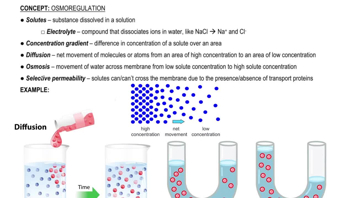
A concentration gradient is a difference in the concentration of a solute across a space or membrane.
What is diffusion?
Diffusion is the movement of molecules from an area of high concentration to an area of low concentration.
What happens if a membrane blocks solute movement but allows water to pass?
Osmosis occurs, where water moves from the area of low solute concentration to high solute concentration.
What is osmosis?
Osmosis is the movement of water across a selectively permeable membrane from low to high solute concentration.
What does selective permeability mean?
Selective permeability refers to a membrane's ability to allow some substances to pass while blocking others.
What is osmolarity?
Osmolarity is a measure of solute concentration, specifically the number of moles of dissolved solute per liter.
What happens to a cell in a hyperosmotic solution?
Water leaves the cell, causing it to shrivel, because the solution outside has a higher osmolarity.
What is an isoosmotic solution?
An isoosmotic solution has the same osmolarity as the cell, so water moves in and out at equal rates.
What happens to a cell in a hypoosmotic solution?
Water enters the cell, causing it to swell, because the solution outside has a lower osmolarity.
What are osmoconformers?
Osmoconformers are organisms that are isosmotic with their environment and do not actively regulate their internal osmolarity.
What are osmoregulators?
Osmoregulators are organisms that actively regulate the osmolarity of their internal environment.
What is anhydrobiosis?
Anhydrobiosis is an adaptation that allows organisms to survive extreme dehydration by drying out.
What is a tardigrade and why is it notable in this context?
A tardigrade, or water bear, is an organism capable of surviving without water for extended periods due to anhydrobiosis.
 BackBack
 07:59
07:59