Back

Redox Reactions quiz

Control buttons has been changed to "navigation" mode.
1/15
  • What does 'redox' stand for in chemistry?

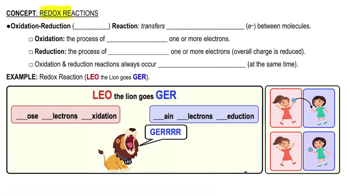
    'Redox' stands for reduction-oxidation, referring to reactions involving the transfer of electrons between molecules.
  • What happens during oxidation in a redox reaction?

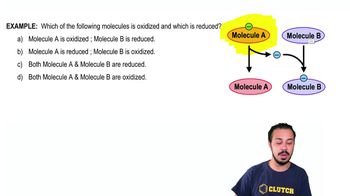
    Oxidation is the process of losing one or more negatively charged electrons.
  • What is reduction in the context of redox reactions?

    Reduction is the process of gaining one or more negatively charged electrons.
  • Why do oxidation and reduction always occur together?

    They always occur together because when one molecule loses electrons (oxidation), another must gain them (reduction).
  • What mnemonic helps remember the definitions of oxidation and reduction?

    The mnemonic 'Leo the lion goes ger' helps remember that Losing Electrons is Oxidation and Gaining Electrons is Reduction.
  • What is the charge of an electron?

    An electron has a negative charge.
  • What are NADH and FADH2 commonly called in the context of redox reactions?

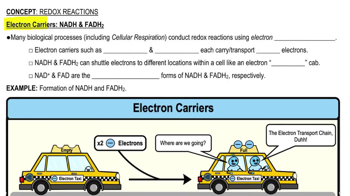
    NADH and FADH2 are called electron carriers or 'electron taxicabs' because they transport electrons within cells.
  • What are the oxidized forms of NADH and FADH2?

    The oxidized forms are NAD+ for NADH and FAD for FADH2.
  • How do NADH and FADH2 differ from their oxidized forms?

    NADH and FADH2 have gained electrons and hydrogen ions, making them heavier than their oxidized forms.
  • How many electrons can NADH and FADH2 each carry?

    Each can carry a maximum of two electrons.
  • What happens to NAD+ when it picks up electrons and a hydrogen ion?

    NAD+ becomes NADH after picking up two electrons and a hydrogen ion.
  • What does FAD become after picking up electrons and hydrogen ions?

    FAD becomes FADH2 after picking up two electrons and two hydrogen ions.
  • During cellular respiration, where do NADH and FADH2 deliver their electrons?

    They deliver their electrons to the electron transport chain, the final stage of cellular respiration.
  • Why are NADH and FADH2 considered the 'full taxicab' versions?

    They are considered 'full' because they have picked up electrons and hydrogen ions, making them heavier.
  • What is the main role of electron carriers in biological redox reactions?

    Their main role is to shuttle electrons to different locations within the cell, facilitating processes like cellular respiration.