Pearson+ LogoPearson+ Logo
Back

Renal Physiology Step 1: Glomerular Filtration quiz #1

Control buttons has been changed to "navigation" mode.
1/19
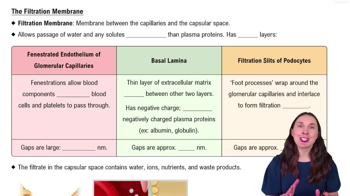
  • What are the three layers of the filtration membrane in the kidneys, and what is the function of each layer?

    The three layers are: (1) fenestrated endothelium, which allows passage of most solutes except blood cells and platelets; (2) basal lamina, a negatively charged gel that repels most plasma proteins; and (3) filtration slits formed by podocytes, which only allow the smallest solutes and water to pass. Together, these layers filter blood while retaining cells and most proteins.
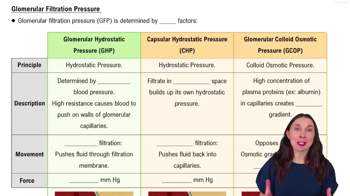
  • Which pressures determine net glomerular filtration pressure, and how do they influence filtration?

    Net glomerular filtration pressure is determined by glomerular hydrostatic pressure (favors filtration), capsular hydrostatic pressure (opposes filtration), and glomerular colloid osmotic pressure (opposes filtration). The net effect is a pressure of about 10 mmHg that drives filtration through the membrane.
  • How is glomerular filtration rate (GFR) defined, and what is its average value in healthy adults?

    GFR is the volume of filtrate formed by both kidneys per minute, averaging about 125 mL/min in healthy adults.
  • How does systemic blood pressure affect glomerular filtration rate (GFR)?

    GFR is positively correlated with systemic blood pressure; increases in blood pressure typically increase GFR, while decreases in blood pressure lower GFR.
  • What are potential health consequences of chronic increases or decreases in glomerular filtration rate?

    Chronic increases in GFR can cause dehydration and electrolyte imbalances due to excessive urine output, while chronic decreases can lead to hypertension, edema, and retention of waste products.
  • What are the three layers of the filtration membrane in the kidneys and what does each layer do?

    The three layers are the fenestrated endothelium (blocks blood cells and platelets), the basal lamina (repels most plasma proteins due to its negative charge), and the filtration slits of podocytes (allow only the smallest solutes and water to pass). Together, they filter blood while retaining cells and most proteins.
  • Which three pressures determine net glomerular filtration pressure and how do they affect filtration?

    Glomerular hydrostatic pressure favors filtration, while capsular hydrostatic pressure and glomerular colloid osmotic pressure both oppose filtration. The net effect is a pressure of about 10 mmHg that drives filtration through the membrane.
  • How is glomerular filtration rate (GFR) defined and what is its average value in healthy adults?

    GFR is the volume of filtrate formed by both kidneys per minute, and it averages about 125 mL/min in healthy adults.
  • How does systemic blood pressure influence glomerular filtration rate (GFR)?

    GFR is positively correlated with systemic blood pressure; increases in blood pressure typically increase GFR, while decreases in blood pressure lower GFR.
  • What health problems can result from chronic increases or decreases in glomerular filtration rate?

    Chronic increases in GFR can cause dehydration and electrolyte imbalances due to excessive urine output, while chronic decreases can lead to hypertension, edema, and retention of waste products.
  • Where in the kidney does blood plasma filtration occur?

    Blood plasma is filtered in the glomerulus of the kidney.
  • What is the specific site in the kidney where filtration takes place?

    Filtration occurs in the glomerulus, which is part of the renal corpuscle in the kidney.
  • In which structure is the blood filtrate collected after passing through the filtration membrane?

    Blood filtrate is captured in the lumen of the capsular space (Bowman's capsule).
  • Through which vessel does blood enter the glomerulus?

    Blood enters the glomerulus via the afferent arteriole.
  • What structure in the kidney is responsible for filtering the blood?

    The filtration membrane of the glomerulus filters the blood.
  • Which part of the kidney is responsible for the filtration process?

    Filtration occurs in the renal corpuscle, specifically in the glomerulus.
  • What is the main force that drives filtration in the kidney?

    The main force driving filtration in the kidney is glomerular hydrostatic pressure, which is largely determined by systemic blood pressure.
  • How does systemic blood pressure affect glomerular filtration rate (GFR)?

    Systemic blood pressure is positively correlated with glomerular filtration rate; as blood pressure increases, GFR increases, and as blood pressure decreases, GFR decreases.
  • Approximately how much filtrate do the kidneys produce per day in a healthy individual?

    The kidneys produce about 180 liters of filtrate per day, based on an average glomerular filtration rate of 125 mL/min.