Pearson+ LogoPearson+ Logo
Back

Simple Epithelial Tissues quiz #1

Control buttons has been changed to "navigation" mode.
1/10
  • Which type of simple epithelial tissue lines most of the digestive tract, and what is its primary function?

    Simple columnar epithelium lines most of the digestive tract, where its primary functions are absorption and secretion. The tall, narrow cells often feature microvilli to increase surface area for efficient nutrient absorption.
  • What structural feature distinguishes all simple epithelial tissues from stratified epithelial tissues?

    All simple epithelial tissues have a single layer of cells with every cell in direct contact with the basement membrane. In contrast, stratified epithelial tissues have two or more layers, and not all cells touch the basement membrane.
  • How does the shape and cytoplasm content of simple squamous cells affect their function?

    Simple squamous cells are flat with minimal cytoplasm, making the tissue extremely thin. This thinness allows for rapid diffusion and smooth flow of liquids across the tissue.
  • Where in the body would you most likely find simple squamous epithelium, and why?

    Simple squamous epithelium is commonly found lining the air sacs of the lungs, capillaries, and Bowman's capsule in the kidneys. These locations require efficient diffusion or filtration of substances.
  • What is a helpful analogy for remembering the appearance of simple squamous epithelial cells under a microscope?

    Simple squamous epithelial cells resemble fried eggs, with flat cell bodies and centrally located nuclei like yolks. This analogy helps recall their flat, scale-like structure.
  • How can you identify simple cuboidal epithelium in a histological image?

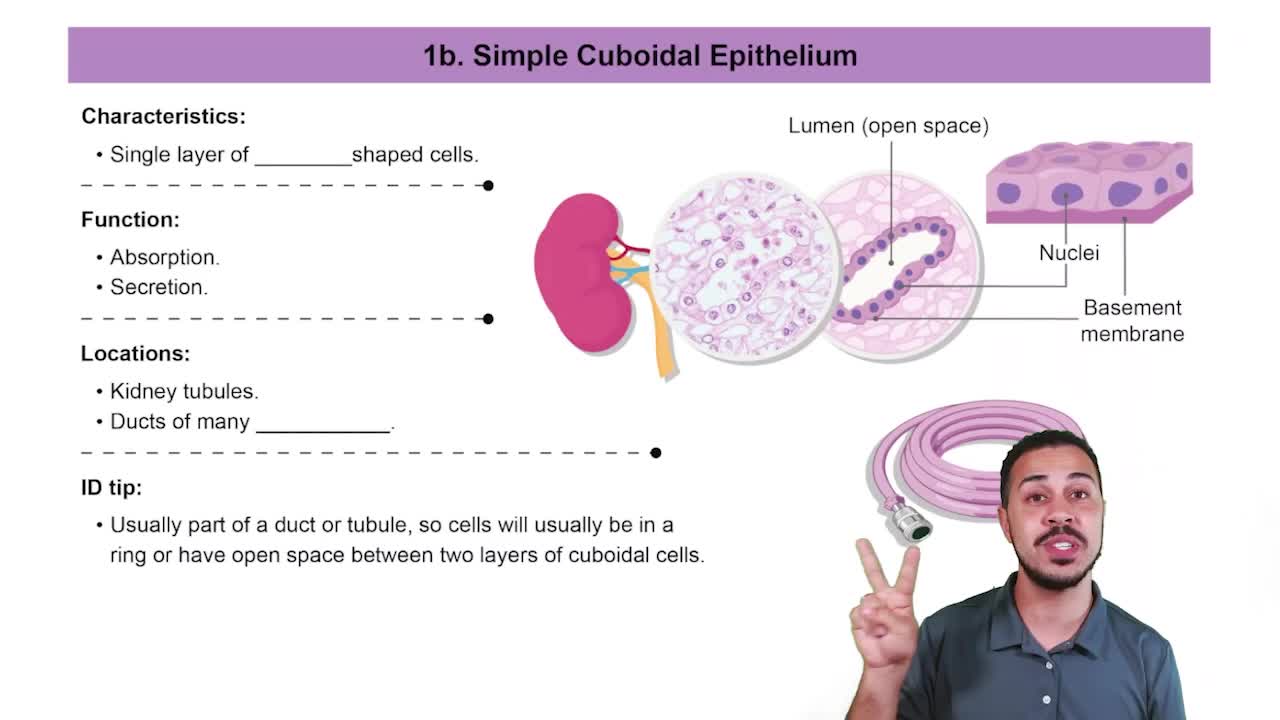
    Simple cuboidal epithelium often appears as a ring of cube-shaped cells forming ducts or tubules, with a central open space called the lumen. This ring structure is commonly seen in kidney tubules and glandular ducts.
  • What is the main difference in cell arrangement between simple columnar and pseudostratified columnar epithelium?

    In simple columnar epithelium, all cells are tall, narrow, and reach the apical surface, forming a uniform layer. In pseudostratified columnar epithelium, cells vary in height and not all reach the apical surface, creating a false appearance of multiple layers.
  • What role do goblet cells play in simple columnar and pseudostratified columnar epithelia?

    Goblet cells are unicellular glands that secrete components forming mucus. This mucus lubricates and protects the lining of organs such as the digestive and respiratory tracts.
  • How do cilia and microvilli differ in their function on simple epithelial tissues?

    Microvilli increase surface area for absorption, especially in the digestive tract. Cilia, on the other hand, move substances like mucus or eggs along the tissue surface, as seen in the respiratory and reproductive tracts.
  • Why might pseudostratified columnar epithelium be mistaken for stratified tissue, and how can you distinguish it?

    Pseudostratified columnar epithelium appears to have multiple layers due to nuclei at different heights, but all cells touch the basement membrane. True stratified tissue has cells in upper layers that do not contact the basement membrane.