Back

Absolute Value Equations definitions

Control buttons has been changed to "navigation" mode.
1/15
  • Absolute Value

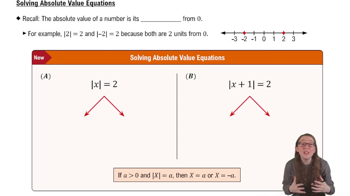
    Represents the distance from zero, always non-negative, regardless of the sign of the original number or expression.
  • Distance

    A measure of how far a value or expression is from zero, never negative, used in absolute value equations.
  • Solution Set

    A collection of values that satisfy an equation, often shown inside curly brackets for absolute value equations.
  • Expression

    A mathematical phrase inside absolute value symbols, which can include variables, constants, or both.
  • Variable

    A symbol, often x, representing an unknown value in equations, including those with absolute value.
  • Constant

    A fixed value, such as a number, appearing in equations or expressions, often used to isolate terms.
  • Equation

    A mathematical statement showing equality between two expressions, sometimes involving absolute value.
  • Curly Brackets

    Symbols used to enclose the solution set for absolute value equations, indicating all valid solutions.
  • Linear Equation

    An equation where the highest power of the variable is one, often solved after removing absolute value symbols.
  • Coefficient

    A number multiplying a variable in an expression, important when solving equations after isolating absolute value.
  • Isolating

    The process of arranging an equation so the absolute value expression stands alone on one side.
  • False Statement

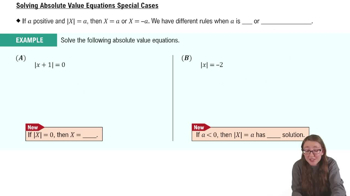
    An equation that cannot be true, such as when absolute value equals a negative number, resulting in no solution.
  • Parentheses

    Symbols used to group expressions, especially when applying negatives to entire expressions in absolute value equations.
  • Negative Number

    A value less than zero, which cannot be the result of an absolute value expression.
  • Positive Number

    A value greater than zero, which allows absolute value equations to have two distinct solutions.