Back

Absolute Value Inequalities quiz

Control buttons has been changed to "navigation" mode.
1/15
  • What is the first step when solving an absolute value inequality?

    The first step is to isolate the absolute value expression on one side of the inequality.
  • How do you rewrite the inequality |x| < a without absolute values?

    You rewrite it as a compound inequality: -a < x < a.
  • What does the inequality |x| > a become when rewritten without absolute values?

    It becomes two inequalities: x > a or x < -a.
  • What does the solution set look like for |x| ≤ a?

    The solution is -a ≤ x ≤ a, a three-part compound inequality.
  • What is the solution to |x| < 0?

    There is no solution, because absolute value cannot be negative.
  • What is the solution to |x| ≤ 0?

    The only solution is x = 0.
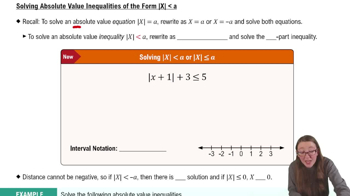
  • How do you solve |x + 1| + 3 ≤ 5?

    First, subtract 3 from both sides to get |x + 1| ≤ 2, then rewrite as -2 ≤ x + 1 ≤ 2 and solve for x.
  • How do you express the solution to -3 ≤ x ≤ 1 in interval notation?

    It is written as [-3, 1] using brackets to include the endpoints.
  • What is the solution to |x + 1| < -1?

    There is no solution, because absolute value cannot be less than a negative number.
  • What is the solution to |x + 1| ≤ 0?

    x + 1 must equal 0, so x = -1.
  • How do you solve |x + 1| + 3 ≥ 5?

    Subtract 3 from both sides to get |x + 1| ≥ 2, then rewrite as x + 1 ≥ 2 or x + 1 ≤ -2 and solve for x.
  • How do you express the solution to x ≥ 1 or x ≤ -3 in interval notation?

    It is written as (-∞, -3] ∪ [1, ∞).
  • What is the solution to |x + 1| ≥ -2?

    The solution is all real numbers, because absolute value is always greater than or equal to a negative number.
  • When solving a three-part inequality, what must you do to all three sides?

    You must perform the same operation to all three sides to keep the inequality balanced.
  • What special case occurs when the number on the other side of the absolute value inequality is negative?

    If the inequality is 'less than' a negative, there is no solution; if 'greater than or equal to' a negative, all real numbers are solutions.