Skip to main content
Beginning & Intermediate Algebra
My Course
Learn
Exam Prep
AI Tutor
Study Guides
Flashcards
Explore
Try the app
My Course
Learn
Exam Prep
AI Tutor
Study Guides
Flashcards
Explore
Try the app
Back
Factoring Special Products quiz
You can tap to flip the card.
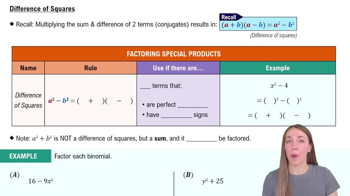
What is the factored form of a difference of squares, a^2 - b^2?
You can tap to flip the card.
👆
What is the factored form of a difference of squares, a^2 - b^2?
It factors as (a + b)(a - b).
Track progress
Control buttons has been changed to "navigation" mode.
1/15
Related flashcards
Related practice
Recommended videos
Factoring Special Products definitions
Factoring Special Products
14 Terms
Factoring Special Products
7. Factoring
5 problems
Topic
ErnestBlazevic
Quadratic Equations & Applications
7. Factoring
5 problems
Topic
ErnestBlazevic
7. Factoring - Part 1 of 2
4 topics
12 problems
Chapter
JustinRaimundo
7. Factoring - Part 2 of 2
1 topic
3 problems
Chapter
ErnestBlazevic
01:17
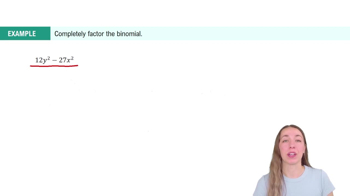
Difference of Squares Example 3
119
views
1
rank
04:13
Difference of Squares
182
views
6
rank
1
comments
02:49
Sum & Difference of Cubes Example 6
119
views
Terms in this set (15)
Hide definitions
What is the factored form of a difference of squares, a^2 - b^2?
It factors as (a + b)(a - b).
What two criteria must be met to use the difference of squares factoring rule?
Both terms must be perfect squares and have opposite signs.
Can the expression a^2 + b^2 be factored using the difference of squares rule?
No, because it is a sum of squares, not a difference.
How would you factor x^2 - 4 using the difference of squares?
It factors as (x + 2)(x - 2).
What is the general form of a perfect square trinomial?
It is a^2 ± 2ab + b^2.
How do you factor a^2 + 2ab + b^2?
It factors as (a + b)^2.
How do you factor a^2 - 2ab + b^2?
It factors as (a - b)^2.
What must be true about the first and last terms in a perfect square trinomial?
They must both be perfect squares.
What must the middle term of a perfect square trinomial equal?
It must equal 2ab, where a and b are the square roots of the first and last terms.
How would you factor x^2 + 10x + 25?
It factors as (x + 5)^2.
How would you factor 4x^2 - 36x + 81?
It factors as (2x - 9)^2.
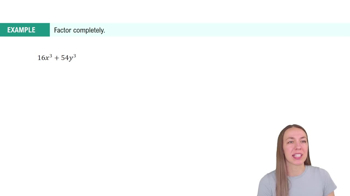
What is the factored form of a sum of cubes, a^3 + b^3?
It factors as (a + b)(a^2 - ab + b^2).
What is the factored form of a difference of cubes, a^3 - b^3?
It factors as (a - b)(a^2 + ab + b^2).
What does the SOAP acronym stand for when factoring cubes?
It stands for Same, Opposite, Always Positive, describing the signs in the factors.
How would you factor 27y^3 - 1?
It factors as (3y - 1)(9y^2 + 3y + 1).
 BackBack

 01:17
01:17