Skip to main content
Beginning & Intermediate Algebra
My Course
Learn
Exam Prep
AI Tutor
Study Guides
Flashcards
Explore
Try the app
My Course
Learn
Exam Prep
AI Tutor
Study Guides
Flashcards
Explore
Try the app
Back
Formulas definitions
You can tap to flip the card.
Formula
You can tap to flip the card.
👆
Formula
An equation with multiple variables used for specific applications, allowing quick calculation by substituting values.
Track progress
Control buttons has been changed to "navigation" mode.
1/15
Related flashcards
Related practice
Recommended videos
Formulas quiz
Formulas
15 Terms
Formulas
3. Solving Word Problems
5 problems
Topic
ErnestBlazevic
Percent Problem Solving
3. Solving Word Problems
5 problems
Topic
ErnestBlazevic
3. Solving Word Problems
4 topics
12 problems
Chapter
ErnestBlazevic
04:45
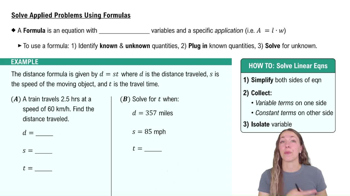
Solve Applied Problems Using Formulas
182
views
5
rank
04:10
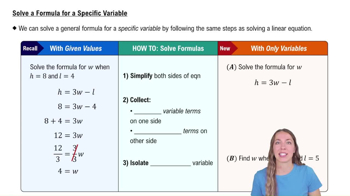
Solve a Formula for a Specific Variable
179
views
3
rank
03:00
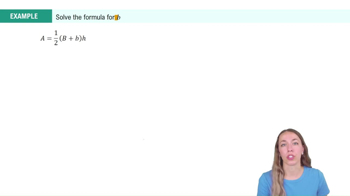
Solve a Formula for a Specific Variable Example 2
155
views
3
rank
Terms in this set (15)
Hide definitions
Formula
An equation with multiple variables used for specific applications, allowing quick calculation by substituting values.
Variable
A placeholder for a number within an equation or formula, representing unknown or changing quantities.
Coefficient
A numerical factor multiplied by a variable in an algebraic expression, indicating how many times the variable is counted.
Exponent
A value indicating how many times a base number or variable is multiplied by itself in an expression.
Linear Equation
An equation where variables appear to the first power and graph as a straight line, often used in formulas.
Constant
A fixed value in an equation or formula that does not change, often representing known quantities.
Distance
A measurement of how far an object travels, often calculated using formulas involving speed and time.
Speed
A rate describing how fast an object moves, typically expressed as distance per unit of time.
Time
A measurement of duration, often used in formulas to determine how long an event or motion lasts.
Standard Form
A way of writing equations or formulas where variables and constants are arranged in a conventional order.
Term
A single part of an algebraic expression, which may be a variable, a constant, or a product of both.
Numerical Coefficient
A number directly multiplying a variable in an expression, showing the variable’s quantity.
Word Problem
A math question presented in sentence form, requiring translation into equations or formulas for solution.
Application
The use of formulas or equations to solve real-world or practical mathematical problems.
Unknown
A quantity in a formula or equation that needs to be determined, often represented by a variable.
 BackBack
 04:45
04:45