Skip to main content
Beginning & Intermediate Algebra
My Course
Learn
Exam Prep
AI Tutor
Study Guides
Flashcards
Explore
Try the app
My Course
Learn
Exam Prep
AI Tutor
Study Guides
Flashcards
Explore
Try the app
Back
Formulas quiz
You can tap to flip the card.
What are the three main steps for using a formula to solve a problem?
You can tap to flip the card.
👆
What are the three main steps for using a formula to solve a problem?
Identify known and unknown quantities, plug in the known quantities, and solve for the unknown.
Track progress
Control buttons has been changed to "navigation" mode.
1/15
Related flashcards
Related practice
Recommended videos
Formulas definitions
Formulas
15 Terms
Formulas
3. Solving Word Problems
5 problems
Topic
ErnestBlazevic
Percent Problem Solving
3. Solving Word Problems
5 problems
Topic
ErnestBlazevic
3. Solving Word Problems
4 topics
12 problems
Chapter
ErnestBlazevic
04:45
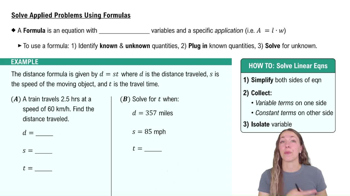
Solve Applied Problems Using Formulas
182
views
5
rank
04:10
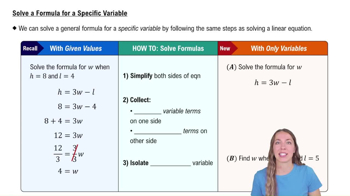
Solve a Formula for a Specific Variable
179
views
3
rank
03:00
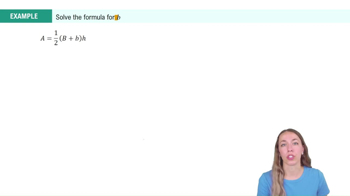
Solve a Formula for a Specific Variable Example 2
155
views
3
rank
Terms in this set (15)
Hide definitions
What are the three main steps for using a formula to solve a problem?
Identify known and unknown quantities, plug in the known quantities, and solve for the unknown.
In the formula d = st, what does each variable represent?
d is distance, s is speed, and t is time.
If a train travels for 2.5 hours at 60 km/h, how do you find the distance traveled?
Multiply speed (60 km/h) by time (2.5 hours) to get distance: d = 150 kilometers.
When solving for time in d = st, and given d and s, what operation do you use?
Divide the distance by the speed: t = d/s.
Why is it important to check units when solving with formulas?
Checking units ensures your answer makes sense and matches the quantity you are solving for.
What is the advantage of isolating a variable in a formula before plugging in values?
It allows you to quickly substitute different values for the other variables and solve efficiently.
What does it mean to 'collect' terms when solving a formula for a variable?
It means gathering all terms with the target variable on one side and all other terms on the opposite side.
How do you isolate a variable that is multiplied by a coefficient in a formula?
Divide both sides of the equation by the coefficient.
If you have the formula 3w = l + h, how do you solve for w?
Divide both sides by 3 to get w = (l + h)/3.
What is the first step when given a formula and values for some variables?
Plug in the known values for the variables into the formula.
How do you solve for a variable in a formula with only variables and no numbers?
Simplify the equation, collect the target variable on one side, and isolate it using algebraic operations.
What is a formula in algebra?
A formula is an equation with multiple variables used for a specific application.
Why might you isolate a variable before plugging in values?
So you can reuse the rearranged formula for different sets of values efficiently.
What should you do if the variable you are solving for is not already isolated in the formula?
Use algebraic steps to isolate the variable, such as adding, subtracting, multiplying, or dividing both sides.
What is the process for solving a formula for a variable when given only variables?
Simplify both sides, collect the target variable, and isolate it by appropriate algebraic operations.
 BackBack
 04:45
04:45