Beginning & Intermediate Algebra
My Course
Learn
AI Tutor
Study Guides
Flashcards
Explore
Try the app
My Course
Learn
AI Tutor
Study Guides
Flashcards
Explore
Try the app
Back
Introduction to Complex Numbers quiz
You can tap to flip the card.
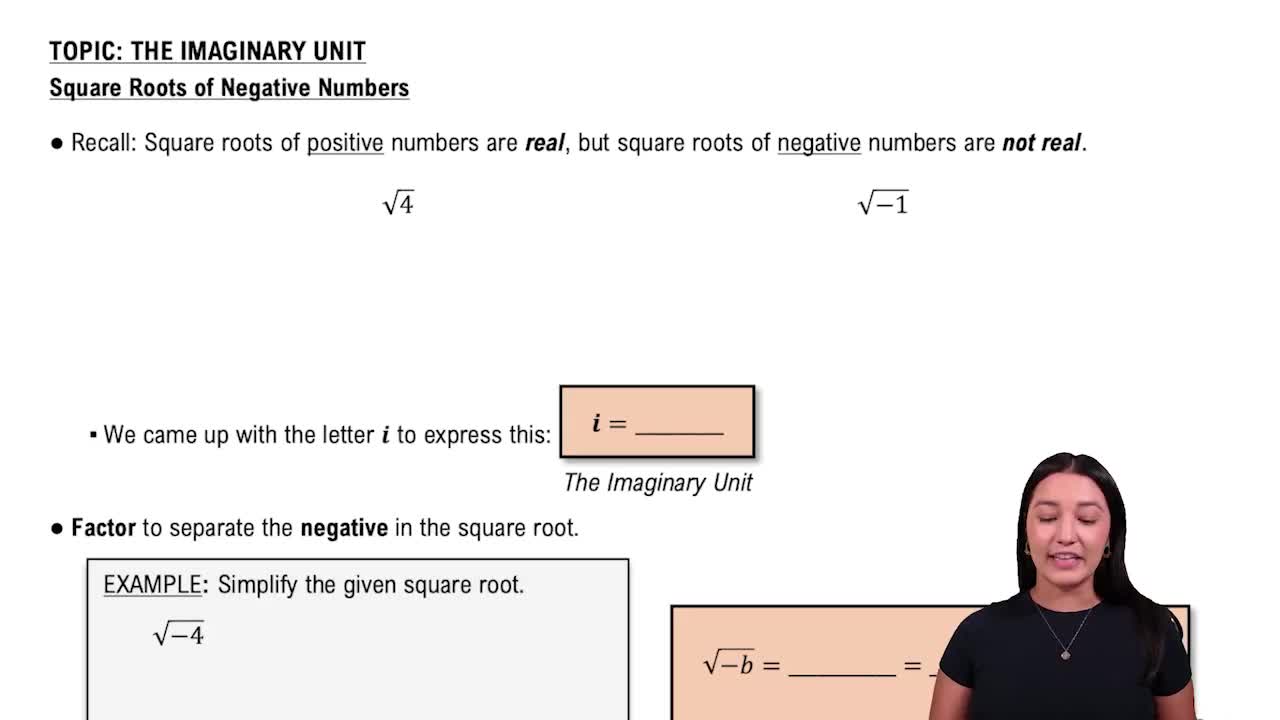
What is the imaginary unit and how is it defined?
You can tap to flip the card.
👆
What is the imaginary unit and how is it defined?
The imaginary unit is 'i', defined as the square root of negative one (i = √-1).
Track progress
Control buttons has been changed to "navigation" mode.
1/15
Related flashcards
Recommended videos
Introduction to Complex Numbers definitions
Introduction to Complex Numbers
15 Terms
03:18
Adding and Subtracting Complex Numbers
61
views
03:31
Introduction to Complex Numbers
58
views
05:02
Square Roots of Negative Numbers
82
views
Terms in this set (15)
Hide definitions
What is the imaginary unit and how is it defined?
The imaginary unit is 'i', defined as the square root of negative one (i = √-1).
How do you simplify the square root of a negative number, such as √-4?
You factor out the negative as √-1, then write it as i times the square root of the positive number; √-4 = 2i.
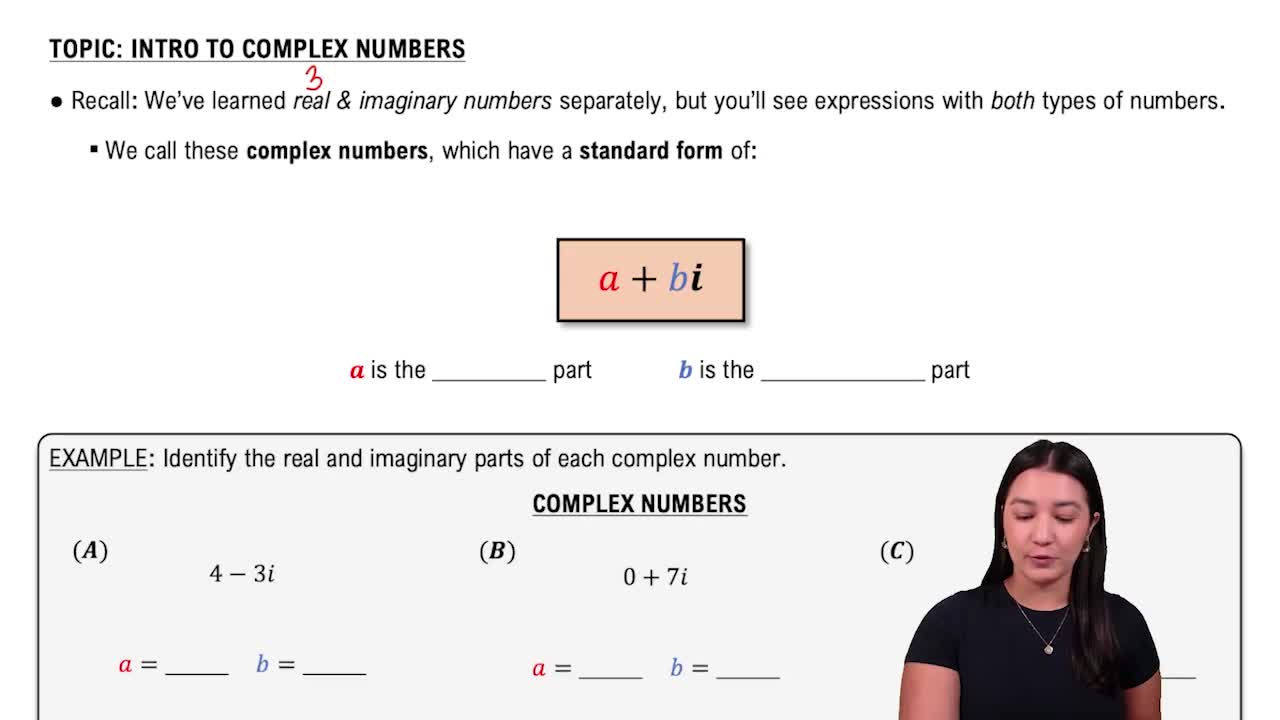
What is the standard form of a complex number?
The standard form is a + bi, where a is the real part and b is the coefficient of the imaginary unit i.
In the complex number 3 + 2i, what are the real and imaginary parts?
The real part is 3, and the imaginary part is 2.
How should you write the answer for √-17?
Write it as i√17, with i before the radical to avoid confusion.
What is the result of simplifying √-32?
The result is 4i√2, with the whole number first, then i, then the radical.
What do you call numbers like 2i, i√17, and 4i√2?
These are called imaginary numbers because they include the imaginary unit i.
What is the real part of the complex number 4 - 3i?
The real part is 4.
What is the imaginary part of the complex number 4 - 3i?
The imaginary part is -3.
If a complex number is 0 + 7i, what are its real and imaginary parts?
The real part is 0, and the imaginary part is 7.
If a complex number is 2 + 0i, what are its real and imaginary parts?
The real part is 2, and the imaginary part is 0.
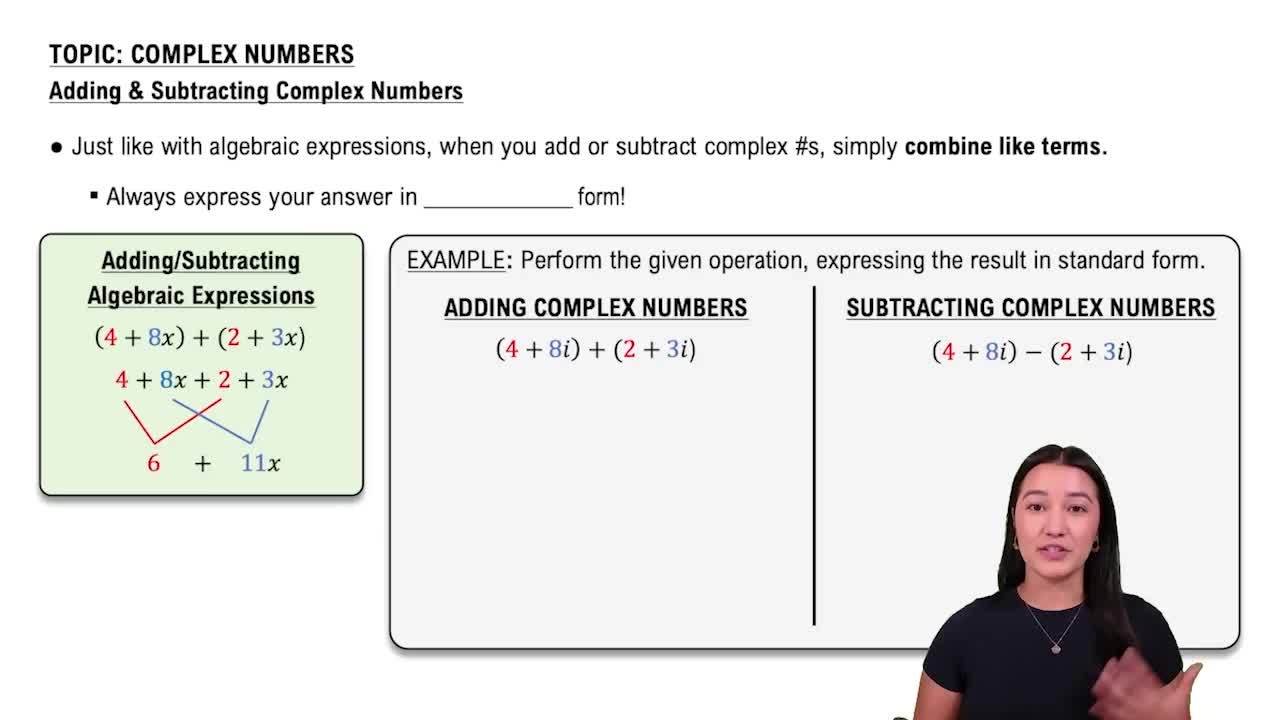
How do you add complex numbers like 4 + 8i and 2 + 3i?
Combine the real parts (4 + 2 = 6) and the imaginary parts (8i + 3i = 11i) to get 6 + 11i.
How do you subtract complex numbers like 4 + 8i minus 2 + 3i?
Subtract the real parts (4 - 2 = 2) and the imaginary parts (8i - 3i = 5i) to get 2 + 5i.
When adding or subtracting complex numbers, how should the answer be written?
Always write the answer in standard form a + bi.
How do you treat the imaginary unit i when combining like terms in complex numbers?
Treat i as if it were a variable, combining terms with i separately from real terms.