Skip to main content
Beginning & Intermediate Algebra
My Course
Learn
Exam Prep
AI Tutor
Study Guides
Flashcards
Explore
Try the app
My Course
Learn
Exam Prep
AI Tutor
Study Guides
Flashcards
Explore
Try the app
Back
Introduction to Inverse Functions definitions
You can tap to flip the card.
Function
You can tap to flip the card.
👆
Function
A relation pairing each input with at most one output, ensuring no input is linked to multiple outputs.
Track progress
Control buttons has been changed to "navigation" mode.
1/13
Related flashcards
Related practice
Recommended videos
Introduction to Inverse Functions quiz
Introduction to Inverse Functions
15 Terms
Introduction to Inverse Functions
13. Inverse, Exponential, & Logarithmic Functions
5 problems
Topic
ZacharyFrye
Exponential Functions
13. Inverse, Exponential, & Logarithmic Functions
5 problems
Topic
ErnestBlazevic
13. Inverse, Exponential, & Logarithmic Functions
4 topics
12 problems
Chapter
ZacharyFrye
02:48
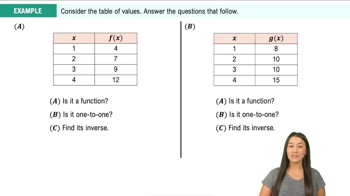
One to One Functions Example 1
154
views
1
rank
06:05
One to One Functions
154
views
03:30
Intro to Inverse Functions Example 2
141
views
Terms in this set (13)
Hide definitions
Function
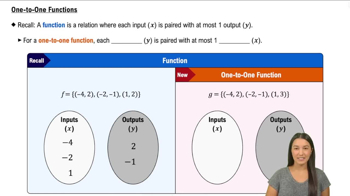
A relation pairing each input with at most one output, ensuring no input is linked to multiple outputs.
One-to-one Function
A mapping where each output is paired with at most one input, confirmed by unique input-output pairs.
Inverse Function
A function that reverses the original mapping, swapping inputs and outputs, denoted with a superscript negative one.
Ordered Pair
A set of two values showing the correspondence between input and output, typically written as (x, y).
Input
A value from the domain that is mapped to an output in a function, often represented as an x value.
Output
A value from the range that results from applying a function to an input, often represented as a y value.
Domain
The complete set of input values for a function, which becomes the range for its inverse.
Range
The complete set of output values for a function, which becomes the domain for its inverse.
Horizontal Line Test
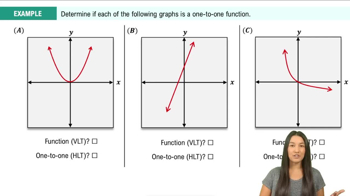
A graphical method to verify one-to-one status by checking if any horizontal line crosses more than one point.
Vertical Line Test
A graphical method to confirm a relation is a function by ensuring vertical lines cross at most one point.
Correspondence Diagram
A visual representation using bubbles and arrows to show how inputs and outputs are paired in a function.
Mapping
The process of associating each input with an output, illustrated by arrows or ordered pairs.
Notation
A symbolic system, such as f⁻¹, used to represent mathematical concepts like inverse functions.
 BackBack

 02:48
02:48