Skip to main content
Beginning & Intermediate Algebra
My Course
Learn
Exam Prep
AI Tutor
Study Guides
Flashcards
Explore
Try the app
My Course
Learn
Exam Prep
AI Tutor
Study Guides
Flashcards
Explore
Try the app
Back
Introduction to Problem Solving definitions
You can tap to flip the card.
Linear Equation
You can tap to flip the card.
👆
Linear Equation
An algebraic statement where variables are raised only to the first power and represent straight-line relationships.
Track progress
Control buttons has been changed to "navigation" mode.
1/15
Related flashcards
Related practice
Recommended videos
Introduction to Problem Solving quiz
Introduction to Problem Solving
15 Terms
Introduction to Problem Solving
3. Solving Word Problems
5 problems
Topic
ErnestBlazevic
Formulas
3. Solving Word Problems
5 problems
Topic
ErnestBlazevic
3. Solving Word Problems
4 topics
12 problems
Chapter
ErnestBlazevic
02:11
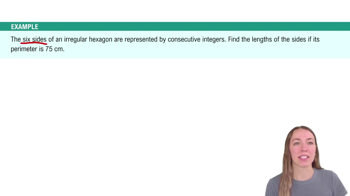
Consecutive Integers Problems Example 2
120
views
2
rank
02:17
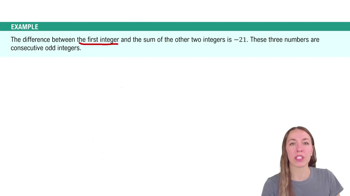
Consecutive Integers Problems Example 3
122
views
5
rank
07:08
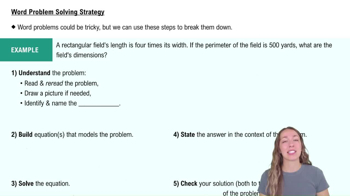
Word Problem Solving Strategy
254
views
4
rank
Terms in this set (15)
Hide definitions
Linear Equation
An algebraic statement where variables are raised only to the first power and represent straight-line relationships.
Variable
A symbol used to represent an unknown quantity, often assigned to clarify problem context and relationships.
Perimeter
The total distance around a shape, calculated by summing all side lengths, often modeled with algebraic expressions.
Equation
A mathematical statement showing equality between two expressions, used to model and solve real-world scenarios.
Consecutive Integer
Whole numbers that follow each other in order on the number line, differing by one.
Consecutive Even Integer
Even numbers that follow each other in order, each differing by two from the previous.
Consecutive Odd Integer
Odd numbers that follow each other in order, each differing by two from the previous.
Substitution
Replacing a variable with its equivalent value or expression to simplify and solve equations.
Model
A representation, often visual or algebraic, used to describe and analyze a real-world situation.
Context
The real-world scenario or background in which a mathematical problem is set, guiding interpretation of solutions.
Sum
The result of adding two or more numbers, frequently used to set up equations in word problems.
Number Line
A visual tool displaying numbers in order, useful for understanding relationships like consecutive values.
Dimension
A measurable extent, such as length or width, often used to describe geometric figures in problems.
Check
The process of verifying a solution by plugging values back into equations and assessing reasonableness.
Translation
Converting verbal statements or relationships into algebraic expressions for problem solving.
 BackBack
 02:11
02:11