Skip to main content
Beginning & Intermediate Algebra
My Course
Learn
Exam Prep
AI Tutor
Study Guides
Flashcards
Explore
Try the app
My Course
Learn
Exam Prep
AI Tutor
Study Guides
Flashcards
Explore
Try the app
Back
Introduction to Problem Solving quiz
You can tap to flip the card.
What are the five steps to solving a word problem?
You can tap to flip the card.
👆
What are the five steps to solving a word problem?
The five steps are: understand the problem, build an equation, solve the equation, state the answer, and check the solution.
Track progress
Control buttons has been changed to "navigation" mode.
1/15
Related flashcards
Related practice
Recommended videos
Introduction to Problem Solving definitions
Introduction to Problem Solving
15 Terms
Introduction to Problem Solving
3. Solving Word Problems
5 problems
Topic
ErnestBlazevic
Formulas
3. Solving Word Problems
5 problems
Topic
ErnestBlazevic
3. Solving Word Problems
4 topics
12 problems
Chapter
ErnestBlazevic
02:11
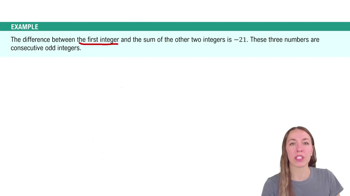
Consecutive Integers Problems Example 2
120
views
2
rank
02:17
Consecutive Integers Problems Example 3
122
views
5
rank
07:08
Word Problem Solving Strategy
254
views
4
rank
Terms in this set (15)
Hide definitions
What are the five steps to solving a word problem?
The five steps are: understand the problem, build an equation, solve the equation, state the answer, and check the solution.
Why is it helpful to draw a picture when solving word problems involving shapes?
Drawing a picture helps model the situation and makes it easier to visualize relationships between variables.
How do you define variables when solving a perimeter problem for a rectangle?
Assign letters to each quantity, such as l for length, w for width, and p for perimeter.
What is the formula for the perimeter of a rectangle?
The perimeter formula is P = 2l + 2w.
How do you use relationships between variables to simplify equations in word problems?
Substitute one variable in terms of another, such as l = 4w, to reduce the number of unknowns.
What should you do after solving for a variable in a word problem?
State the answer in the context of the problem and check if it makes sense.
How do you check your solution in a word problem?
Plug your values back into the original equation and verify they fit the context of the problem.
What are consecutive integers?
Consecutive integers are whole numbers that follow each other in order, differing by one.
How do you represent two consecutive integers algebraically?
Let the first integer be x and the second be x + 1.
How do you set up an equation for two consecutive integers whose sum is known?
Write x + (x + 1) = sum, then solve for x.
What are consecutive even integers and how do you represent them?
Consecutive even integers differ by two; represent them as x and x + 2.
How do you solve for two consecutive even integers whose sum is given?
Set up the equation x + (x + 2) = sum, combine like terms, and solve for x.
Why is it important to check if your answer fits the context of the problem?
It ensures your solution is reasonable and matches the real-world scenario described.
What should you do if your solution does not make sense in the context of the problem?
Re-examine your steps and calculations to find and correct any mistakes.
How can translating real-world scenarios into algebraic expressions help in problem solving?
It allows you to use mathematical techniques to find solutions and enhances your understanding of algebraic concepts.
 BackBack
 02:11
02:11