Back

Least Common Denominators definitions

Control buttons has been changed to "navigation" mode.
1/15
  • Least Common Denominator

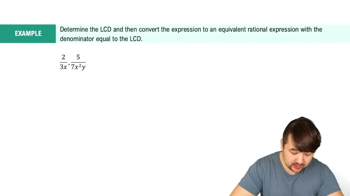
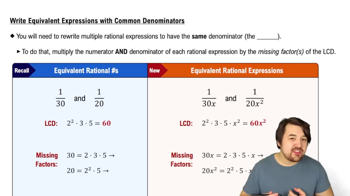
    Smallest expression that all denominators can divide into, found by multiplying unique prime factors at their highest powers.
  • Rational Expression

    Fraction where both numerator and denominator are polynomials, often requiring common denominators for operations.
  • Prime Factor

    Basic building block of a number or variable, used to break down denominators for finding common denominators.
  • Exponent

    Indicates how many times a factor is used in multiplication, crucial for selecting highest powers in LCD.
  • Coefficient

    Numerical part of a term, important when factoring denominators and identifying missing factors.
  • Quadratic Polynomial

    Expression with a squared variable term, often requiring factoring to find unique prime factors.
  • Common Denominator

    Shared denominator between fractions or expressions, enabling addition or subtraction.
  • Missing Factor

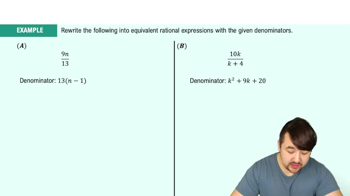
    Element absent from a denominator compared to the LCD, used to rewrite equivalent expressions.
  • Equivalent Expression

    Form of a rational expression with a common denominator, achieved by multiplying by missing factors.
  • Unique Prime Factor

    Distinct factor present in at least one denominator, included at its highest power when forming the LCD.
  • Factoring

    Process of breaking down numbers or polynomials into their basic components for LCD determination.
  • Variable

    Symbol representing an unknown value, treated as a factor when finding LCD for rational expressions.
  • Term

    Individual part of an expression, consisting of coefficients, variables, and exponents.
  • Polynomial

    Expression made up of terms with variables and coefficients, often found in denominators.
  • Rational Number

    Number expressed as a fraction, foundational for understanding LCD in rational expressions.