Back

Least Common Denominators quiz

Control buttons has been changed to "navigation" mode.
1/15
  • What is the first step in finding the least common denominator (LCD) for rational expressions?

    The first step is to factor each denominator completely into its prime factors and variables.
  • When listing unique prime factors for the LCD, which exponent do you use if a factor appears with different exponents?

    You use the highest exponent that appears for each unique factor.
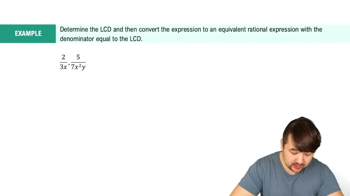
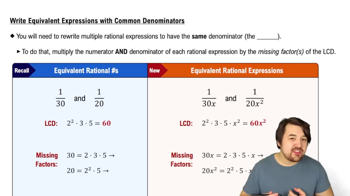
  • How do you find the LCD of 30x and 20x^2?

    Factor both denominators, list all unique factors with their highest exponents, and multiply them: LCD = 60x^2.
  • Why do you only write each unique prime factor once when finding the LCD?

    Because the LCD should include each factor only once, raised to its highest power found in any denominator.
  • How do you handle variables like x when finding the LCD?

    Treat variables like prime factors and use the highest power of the variable present in any denominator.
  • What is the LCD of denominators x + 5 and (x + 2)(x + 5)?

    The LCD is (x + 2)(x + 5), since both factors must be included.
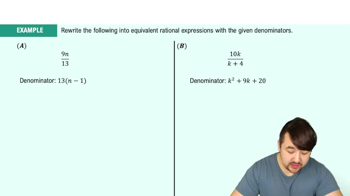
  • What do you do after finding the LCD to write equivalent rational expressions?

    Multiply the numerator and denominator of each fraction by the missing factors needed to match the LCD.
  • If the denominator is 30, and the LCD is 60, what factor is missing from 30?

    The missing factor is 2, since 30 × 2 = 60.
  • How do you rewrite 1/30 as an equivalent fraction with denominator 60?

    Multiply numerator and denominator by 2 to get 2/60.
  • What is the missing factor for 20x^2 if the LCD is 60x^2?

    The missing factor is 3, since 20x^2 × 3 = 60x^2.
  • Why is factoring denominators important when finding the LCD for rational expressions?

    Factoring reveals all the prime and variable factors, making it possible to identify the LCD correctly.
  • What is the LCD for the denominators x^2 + 7x + 10 and 2x(x + 5)?

    First factor x^2 + 7x + 10 as (x + 2)(x + 5); the LCD is 2x(x + 2)(x + 5).
  • How do you determine what to multiply the numerator and denominator by when rewriting with the LCD?

    Multiply by the factors present in the LCD but missing from the original denominator.
  • What is the process for finding the LCD of rational numbers and rational expressions similar?

    Both involve factoring denominators and using the highest powers of all unique factors.
  • After rewriting rational expressions with the LCD, what is the benefit for addition or subtraction?

    Having common denominators allows you to add or subtract the numerators directly.