Back

Linear Inequalities in Two Variables definitions

Control buttons has been changed to "navigation" mode.
1/15
  • Linear Inequality

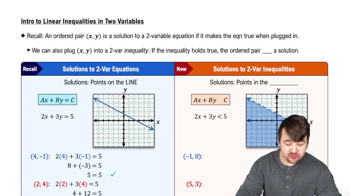
    A mathematical statement involving two variables and an inequality symbol, representing a region on a graph rather than a single line.
  • Ordered Pair

    A set of two numbers representing the x and y coordinates of a point, used to test if it satisfies an inequality.
  • Solution Region

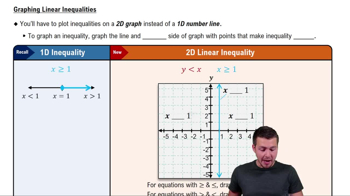
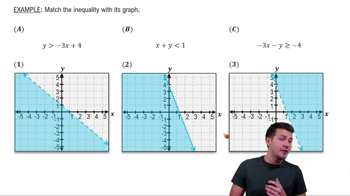
    The area on a graph where all points satisfy a given linear inequality, often shown by shading.
  • Solid Line

    A boundary on a graph drawn when the inequality includes equality, indicating points on the line are solutions.
  • Dashed Line

    A boundary on a graph drawn when the inequality excludes equality, indicating points on the line are not solutions.
  • Slope-Intercept Form

    An equation format where y is isolated, making it easier to graph and determine which region to shade for an inequality.
  • Inequality Symbol

    A sign such as <, >, ≤, or ≥ that determines the relationship between two expressions and affects graphing rules.
  • Test Point

    A specific coordinate chosen to check which side of a boundary satisfies the inequality, guiding shading decisions.
  • Y-Intercept

    The point where a line crosses the y-axis, useful for graphing the boundary of a linear inequality.
  • Standard Form

    An equation format ax + by = c, which can be adapted for inequalities to describe boundaries in two variables.
  • Boundary Line

    The line representing the equality part of an inequality, separating solution regions from non-solution regions.
  • Shaded Region

    The portion of a graph marked to show all points that satisfy a linear inequality in two variables.
  • X-Axis

    The horizontal axis on a graph, often used for selecting test points or identifying boundary lines.
  • Y-Axis

    The vertical axis on a graph, useful for plotting points and understanding solution regions.
  • Multivariable Polynomial

    An expression involving more than one variable, forming the basis for equations and inequalities in two dimensions.