Back

Linear Inequalities in Two Variables quiz

Control buttons has been changed to "navigation" mode.
1/15
  • What is the first step when graphing a linear inequality in two variables?

    The first step is to graph the corresponding line by replacing the inequality symbol with an equal sign.
  • How do you decide whether to use a solid or dashed line when graphing an inequality?

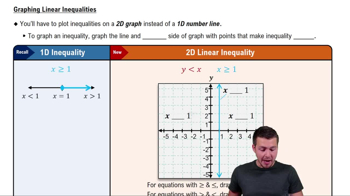
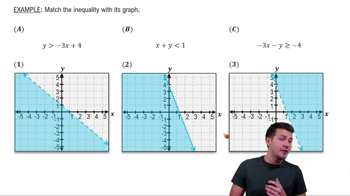
    Use a solid line for ≤ or ≥, and a dashed line for < or >.
  • What does the shaded region on a graph of a linear inequality represent?

    The shaded region represents all the ordered pairs (x, y) that satisfy the inequality.
  • How can you determine which side of the line to shade for a linear inequality?

    Test a point not on the line (often (0,0) or (0,1)) in the inequality; if it makes the inequality true, shade that side.
  • What is the difference between the solution set of a linear equation and a linear inequality in two variables?

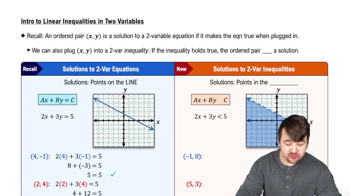
    A linear equation's solutions lie on the line, while a linear inequality's solutions form a region on the graph.
  • If the inequality is y > 2x - 4, which region should be shaded?

    Shade the region above the line y = 2x - 4.
  • What does it mean if an ordered pair makes the inequality true when substituted for x and y?

    It means the ordered pair is a solution to the inequality and lies within the shaded region.
  • What happens if an ordered pair does not satisfy the inequality when substituted?

    The ordered pair is not a solution and lies outside the shaded region.
  • When graphing x ≥ 1 on a two-dimensional graph, which region is shaded?

    Shade all points to the right of the vertical line x = 1.
  • How do you graph y < x on a coordinate plane?

    Draw a dashed line for y = x and shade the region below the line.
  • What shortcut can you use if the inequality is in slope-intercept form (y > mx + b or y < mx + b)?

    If y > mx + b, shade above the line; if y < mx + b, shade below the line.
  • What does the bar under the inequality symbol indicate when graphing?

    The bar means the line itself is included in the solution set, so use a solid line.
  • How do you check if a point is a solution to a linear inequality?

    Substitute the point's x and y values into the inequality; if the statement is true, it's a solution.
  • What is the standard form of a linear equation and how does it change for an inequality?

    The standard form is ax + by = c; for an inequality, it becomes ax + by < c (or another inequality symbol).
  • Why is it easier to test points on the x or y axis when determining which region to shade?

    Points on the axes often have zero for one variable, simplifying calculations when testing the inequality.