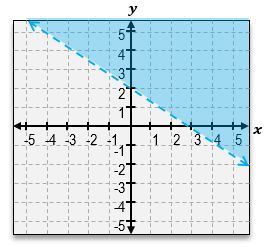
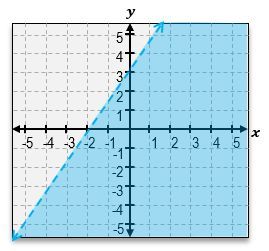
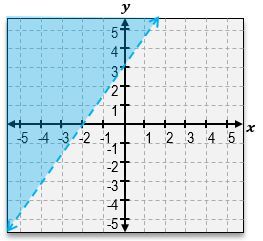
Understanding solutions to two-variable linear inequalities builds on the concept of ordered pairs that satisfy equations. An ordered pair, written as (x, y), is a solution to an equation if substituting these values into the equation makes it true. For example, if plugging in x = 4 and y = -1 results in a true statement like 5 = 5, then (4, -1) lies on the line represented by the equation. However, when dealing with inequalities such as ax + by < c, solutions are not limited to points on a line but instead form a region on the graph.
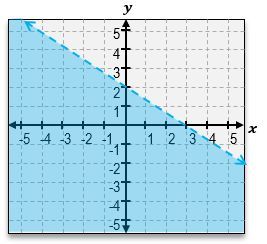
To determine if an ordered pair is a solution to a linear inequality, substitute the x and y values into the inequality. If the inequality holds true, the point is a solution and lies within the shaded region representing all possible solutions. For instance, consider the inequality \(2x + 3y < 5\). Testing the point (-1, 0) gives:
\[2(-1) + 3(0) < 5\] \[-2 + 0 < 5\] \[-2 < 5\]Since this is true, (-1, 0) is a solution and lies inside the shaded region on the graph. Unlike equations where solutions lie exactly on the line, inequalities include all points in a region defined by the inequality symbol.
Testing another point, such as (5, 3), helps illustrate points outside the solution region:
\[2(5) + 3(3) < 5\] \[10 + 9 < 5\] \[19 < 5\]This is false, so (5, 3) is not a solution and lies outside the shaded region. Graphically, the solution set for an inequality is represented by shading the area where all solutions lie, either above or below the boundary line depending on the inequality.
It is important to note the role of the inequality symbol. If the inequality is strict, such as < or >, the boundary line itself is not included in the solution set, so points on the line are not solutions. However, if the inequality includes equality, such as ≤ or ≥, then points on the line are included as solutions. This distinction affects how the graph is drawn: a solid line indicates inclusion of boundary points, while a dashed line indicates exclusion.
By understanding how to test ordered pairs and interpret the inequality symbol, one can accurately identify solution sets for linear inequalities in two variables. This foundational skill is essential for graphing inequalities and solving real-world problems involving constraints.