Back

Multiplying and Dividing Rational Expressions quiz

Control buttons has been changed to "navigation" mode.
1/15
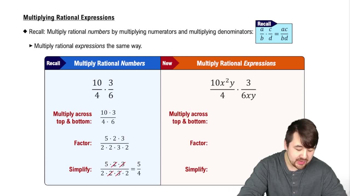
  • How do you multiply two rational expressions?

    Multiply the numerators together and the denominators together, then simplify by canceling common factors.
  • What is the first step in simplifying a rational expression after multiplying?

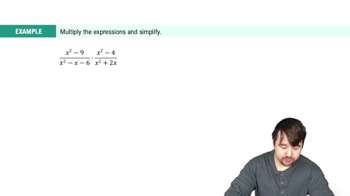
    Factor both the numerator and denominator to identify and cancel common factors.
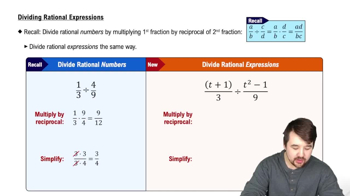
  • What does the 'keep, change, flip' method refer to when dividing rational expressions?

    It means keep the first fraction, change the division to multiplication, and flip the second fraction (take its reciprocal).
  • How do you divide one rational expression by another?

    Multiply the first rational expression by the reciprocal of the second, then simplify.
  • Why is factoring important when simplifying rational expressions?

    Factoring reveals common terms in the numerator and denominator that can be canceled to simplify the expression.
  • What is the difference of squares and how is it used in simplifying rational expressions?

    The difference of squares is an expression like a^2 - b^2, which factors to (a + b)(a - b); this helps in canceling terms.
  • What should you do if you see variables in both the numerator and denominator when simplifying?

    Cancel any common variable factors that appear in both the numerator and denominator.
  • When multiplying rational expressions, do you need a common denominator?

    No, you multiply straight across without finding a common denominator.
  • What is the reciprocal of a rational expression?

    It is the expression with the numerator and denominator switched.
  • What is the purpose of canceling common factors in rational expressions?

    Canceling common factors simplifies the expression to its lowest terms.
  • If you have 10x^2y/4xy multiplied by 3/6, what is the first step to simplify?

    Multiply the numerators and denominators, then factor each part to look for common factors to cancel.
  • How do you handle coefficients when simplifying rational expressions?

    Factor the coefficients into primes and cancel any common factors with the denominator.
  • What happens if you do not factor before simplifying a rational expression?

    You may miss common factors and not fully simplify the expression.
  • What is the result of dividing 1/3 by 4/9 using the keep, change, flip method?

    You multiply 1/3 by 9/4 to get 9/12, which simplifies to 3/4.
  • Why is it helpful to factor expressions completely when simplifying rational expressions?

    Factoring completely ensures all possible common factors are identified and canceled for full simplification.