Back

Negative Exponents definitions

Control buttons has been changed to "navigation" mode.
1/14
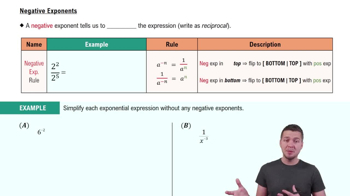
  • Negative Exponent

    Indicates the reciprocal of the base raised to the positive exponent, allowing conversion to a positive exponent by flipping the base.
  • Reciprocal

    Result of flipping a fraction so the numerator becomes the denominator and vice versa, used to rewrite negative exponents.
  • Base

    The number or variable that is repeatedly multiplied in an exponential expression, affected by exponent rules.
  • Exponent

    A value showing how many times the base is multiplied by itself, can be positive or negative in expressions.
  • Fraction

    An expression with a numerator and denominator, used to demonstrate flipping negative exponents between top and bottom.
  • Numerator

    The top part of a fraction, where a negative exponent can be moved to the denominator to become positive.
  • Denominator

    The bottom part of a fraction, where a negative exponent can be moved to the numerator to become positive.
  • Quotient Rule

    A rule stating that exponents with the same base in a fraction can be subtracted, often resulting in negative exponents.
  • Simplification

    The process of rewriting expressions to eliminate negative exponents and make calculations easier.
  • Variable

    A symbol representing an unknown value, often used as the base in exponential expressions.
  • Positive Exponent

    Shows repeated multiplication of the base, resulting from converting a negative exponent by flipping the base.
  • Expression

    A mathematical phrase containing numbers, variables, and exponents, often simplified using exponent rules.
  • Factor

    A number or variable multiplied in an expression, visible when expanding exponents to show repeated multiplication.
  • Evaluation

    The process of calculating the value of an expression, such as finding the result of a positive exponent.