Back

Negative Exponents quiz

Control buttons has been changed to "navigation" mode.
1/15
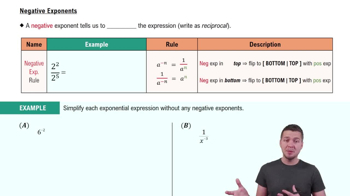
  • What does a negative exponent indicate in an expression like a^-n?

    A negative exponent indicates the reciprocal of the base raised to the positive exponent, so a^-n = 1/a^n.
  • How do you rewrite 2^-3 with a positive exponent?

    2^-3 can be rewritten as 1/(2^3).
  • What is the result of simplifying 6^-2?

    6^-2 simplifies to 1/(6^2), which is 1/36.
  • If you have a negative exponent in the numerator, what should you do?

    You should move the base with the negative exponent to the denominator and make the exponent positive.
  • How do you handle a negative exponent in the denominator, such as 1/x^-3?

    Move the base with the negative exponent to the numerator and make the exponent positive, so 1/x^-3 = x^3.
  • What does it mean to 'flip' an expression when dealing with negative exponents?

    Flipping means writing the reciprocal of the base and changing the exponent to positive.
  • What is the simplified form of (2^2)/(2^5)?

    (2^2)/(2^5) simplifies to 2^-3, which is 1/(2^3).
  • Why is there an 'invisible one' in the numerator when all terms cancel out?

    When all terms cancel, the numerator becomes 1 because any number divided by itself is 1.
  • Can you always rewrite a negative exponent as a positive exponent?

    Yes, by moving the base to the opposite part of the fraction and making the exponent positive.
  • What is the general rule for negative exponents in fractions?

    Move the base with the negative exponent across the fraction bar and make the exponent positive.
  • How would you simplify x^-4?

    x^-4 simplifies to 1/(x^4).
  • If you have 1/(y^-2), what is the simplified form?

    1/(y^-2) simplifies to y^2.
  • What is the purpose of converting negative exponents to positive exponents?

    It simplifies expressions and makes them easier to work with, especially in further calculations.
  • How does the negative exponent rule help with scientific notation?

    It allows you to express very small numbers as reciprocals with positive exponents, which is common in scientific notation.
  • What should you do if you see a negative exponent in a variable in the denominator?

    Move the variable to the numerator and change the exponent to positive.