Skip to main content
Beginning & Intermediate Algebra
My Course
Learn
Exam Prep
AI Tutor
Study Guides
Flashcards
Explore
Try the app
My Course
Learn
Exam Prep
AI Tutor
Study Guides
Flashcards
Explore
Try the app
Back
Percent Problem Solving quiz
You can tap to flip the card.
How do you convert a percent to a decimal for calculations?
You can tap to flip the card.
👆
How do you convert a percent to a decimal for calculations?
Divide the percent by 100, moving the decimal point two places to the left.
Track progress
Control buttons has been changed to "navigation" mode.
1/15
Related flashcards
Related practice
Recommended videos
Percent Problem Solving definitions
Percent Problem Solving
15 Terms
Percent Problem Solving
3. Solving Word Problems
5 problems
Topic
ErnestBlazevic
Mixture Problem Solving
3. Solving Word Problems
5 problems
Topic
JustinRaimundo
3. Solving Word Problems
4 topics
12 problems
Chapter
ErnestBlazevic
01:45
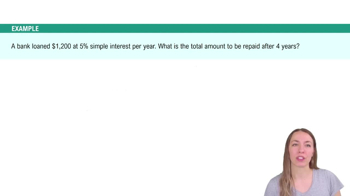
Simple Interest Example 5
89
views
1
rank
03:09
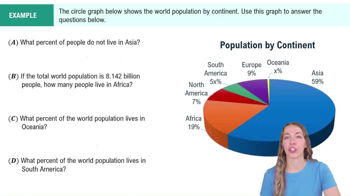
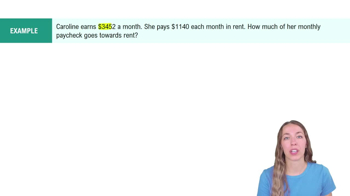
Translating Percent Problems Example 3
142
views
3
rank
00:44
Translating Percent Problems Example 2
141
views
3
rank
Terms in this set (15)
Hide definitions
How do you convert a percent to a decimal for calculations?
Divide the percent by 100, moving the decimal point two places to the left.
What does the word 'is' mean when translating percent word problems?
'Is' means 'equals' in the equation translation.
What does the word 'of' mean in percent problem translations?
'Of' means multiplication in the equation translation.
How would you translate 'A number is 10% of 50' into an equation?
Translate it as x = 0.1 × 50.
What is the general form for percent problems involving partial, percent, and whole amounts?
Partial amount = percent (as decimal) × whole amount.
How do you solve 'Four is 5% of what number?'
Set up 4 = 0.05 × x, then solve for x by dividing 4 by 0.05 to get x = 80.
How do you convert a decimal back to a percent?
Move the decimal point two places to the right and add the percent sign.
What does it mean if a percent is greater than 100% in a problem?
It means the partial amount is greater than the whole amount.
What is the formula for percent change?
Percent Change = (New - Original) / Original × 100%.
How do you determine if a percent change is an increase or decrease?
If the change is positive, it's an increase; if negative, it's a decrease.
How do you calculate the percent change when the price goes from \$50 to \$60?
Subtract 50 from 60 to get 10, divide by 50 to get 0.2, then convert to 20%.
How do you find the percent decrease when a population drops from 12,000 to 8,000?
Subtract 12,000 from 8,000 to get -4,000, divide by 12,000 to get -0.33, then convert to -33%.
What is a discount in percent problem contexts?
A discount is the amount by which the price of an item decreases.
How do you calculate the new price after an 85% discount on \$385?
Multiply 0.85 × 385 to get the discount, then subtract it from 385 for the new price.
What is the simple interest formula and what do its variables represent?
I = PRT, where I is interest, P is principal, R is rate (as decimal), and T is time.
 BackBack

 01:45
01:45