Skip to main content
Beginning & Intermediate Algebra
My Course
Learn
Exam Prep
AI Tutor
Study Guides
Flashcards
Explore
Try the app
My Course
Learn
Exam Prep
AI Tutor
Study Guides
Flashcards
Explore
Try the app
Back
Quadratic Equations & Applications definitions
You can tap to flip the card.
Quadratic Equation
You can tap to flip the card.
👆
Quadratic Equation
A mathematical expression in which the highest exponent of the variable is two, often used to model real-world situations.
Track progress
Control buttons has been changed to "navigation" mode.
1/15
Related flashcards
Related practice
Recommended videos
Quadratic Equations & Applications quiz
Quadratic Equations & Applications
15 Terms
Quadratic Equations & Applications
7. Factoring
5 problems
Topic
ErnestBlazevic
Factoring Special Products
7. Factoring
5 problems
Topic
ErnestBlazevic
7. Factoring - Part 1 of 2
4 topics
12 problems
Chapter
JustinRaimundo
7. Factoring - Part 2 of 2
1 topic
3 problems
Chapter
ErnestBlazevic
04:41
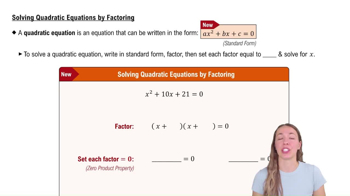
Solving Quadratic Equations by Factoring
226
views
3
rank
02:49
Applications of Quadratic Equations Example 2
126
views
1
rank
01:41
Applications of Quadratic Equations Example 6
102
views
1
rank
Terms in this set (15)
Hide definitions
Quadratic Equation
A mathematical expression in which the highest exponent of the variable is two, often used to model real-world situations.
Standard Form
An arrangement of terms where the equation is written as ax² + bx + c = 0, making it easier to solve.
Trinomial
An algebraic expression composed of three terms, typically seen in quadratic equations.
Binomial
An algebraic expression with two terms, often resulting from factoring a quadratic.
Zero Product Property
A principle stating that if the product of two factors is zero, at least one factor must be zero.
Coefficient
A numerical value multiplying a variable, indicating its contribution to the term.
Exponent
A number showing how many times a variable is multiplied by itself, crucial in identifying quadratic equations.
Factor
A number or expression that divides another without leaving a remainder, used to break down quadratics.
Solution
A value for the variable that makes the equation true, often found by factoring and applying properties.
Polynomial
An expression consisting of variables and coefficients, combined using addition, subtraction, and multiplication.
Degree
The highest exponent in a polynomial, indicating its complexity and type.
Area
A measure of surface, often calculated in application problems involving quadratics.
Length
A linear measurement, frequently used as a variable in quadratic application scenarios.
Width
A linear measurement perpendicular to length, commonly appearing in quadratic word problems.
Variable
A symbol representing an unknown quantity, solved for in quadratic equations.
 BackBack

 04:41
04:41