Back

Rational Equations definitions

Control buttons has been changed to "navigation" mode.
1/15
  • Rational Equation

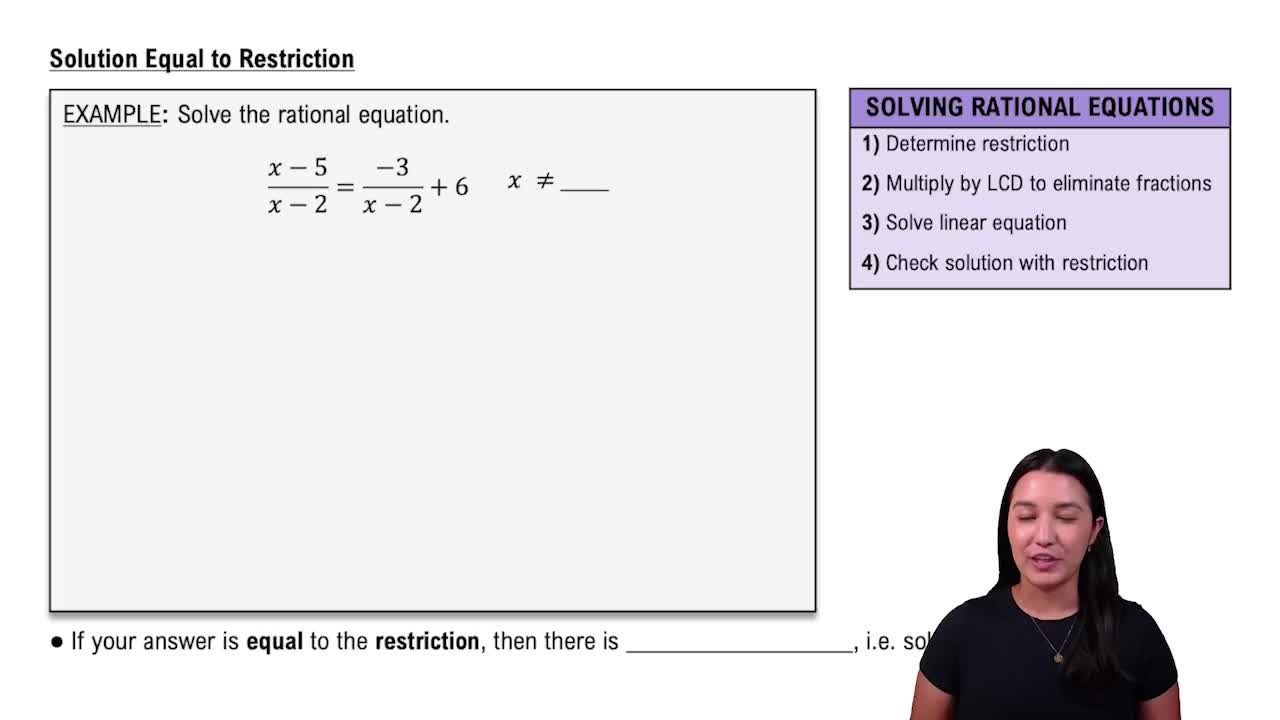
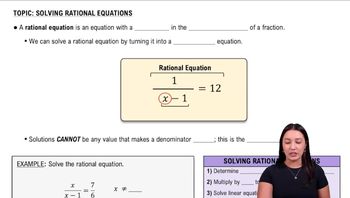
    An equation containing a variable in the denominator, requiring special steps to solve and check for valid solutions.
  • Denominator

    The bottom part of a fraction, whose value must never be zero to avoid undefined expressions.
  • Restriction

    A value that makes the denominator zero, which cannot be a solution to the equation.
  • Least Common Denominator

    The smallest expression that all denominators share, used to clear fractions from an equation.
  • Linear Equation

    An equation with no variables in the denominator, solved using familiar algebraic methods.
  • Fraction

    A numerical expression with a numerator and denominator, often present in rational equations.
  • Solution

    A value for the variable that makes the equation true, provided it does not violate any restrictions.
  • Empty Set

    A result indicating no valid solution exists for the equation, often due to restrictions.
  • Variable

    A symbol representing an unknown value, frequently found in denominators of rational equations.
  • Parenthesis

    Grouping symbols used to clarify order of operations, especially when distributing terms.
  • Constant

    A fixed value in an equation, often separated from variable terms during solving.
  • Like Terms

    Terms with the same variable and exponent, combined to simplify equations.
  • Distribution

    The process of multiplying a term across terms inside parentheses to simplify equations.
  • Numerator

    The top part of a fraction, representing the quantity divided by the denominator.
  • Solution Set

    The collection of all valid solutions for an equation, which may be empty if restrictions are violated.