Back

Rational Equations quiz

Control buttons has been changed to "navigation" mode.
1/15
  • What is a rational equation?

    A rational equation is an equation that has a variable in the denominator of a fraction.
  • Why can't the denominator of a rational equation be zero?

    If the denominator is zero, the expression is undefined, so any value that makes the denominator zero cannot be a solution.
  • What is a restriction in a rational equation?

    A restriction is a value that makes the denominator zero, and therefore cannot be a solution to the equation.
  • What is the first step in solving a rational equation?

    The first step is to determine the restriction by setting the denominator equal to zero and solving for the variable.
  • How do you eliminate fractions in a rational equation?

    Multiply both sides of the equation by the least common denominator (LCD) to eliminate all fractions.
  • What is the least common denominator (LCD) in rational equations?

    The LCD is the smallest expression that all denominators divide into, often found by multiplying the denominators together if they have no common factors.
  • After multiplying by the LCD, what type of equation do you usually get?

    You usually get a linear equation, which can be solved using familiar algebraic methods.
  • What should you do after solving the linear equation from a rational equation?

    Check the solution against the restriction to ensure it does not make any denominator zero.
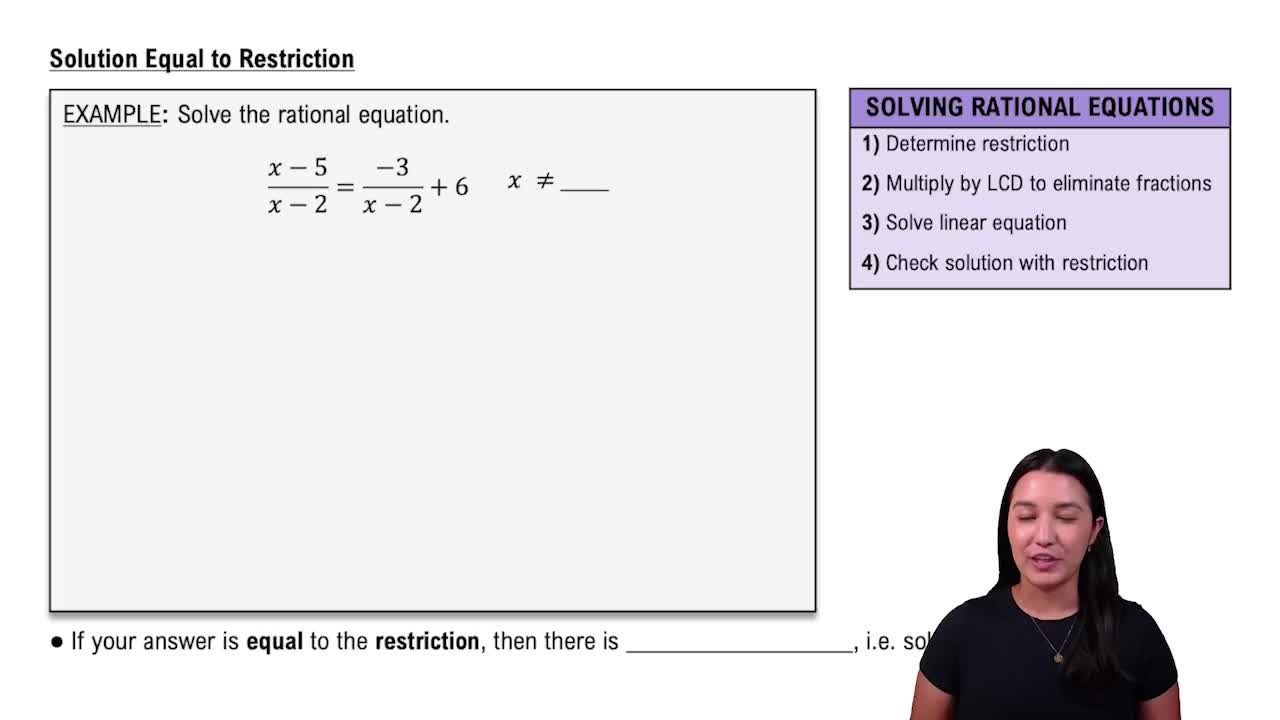
  • What happens if your solution equals the restriction?

    If your solution equals the restriction, there is no solution to the equation, and the solution set is the empty set.
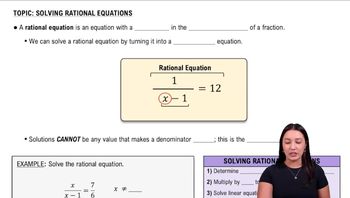
  • How do you determine the restriction for x in the equation x/(x-1) = 76?

    Set the denominator x-1 equal to zero, so x cannot be 1.
  • What is the LCD for the equation x/(x-1) = 7/6?

    The LCD is 6(x-1), since the denominators are 6 and x-1.
  • What is the solution to the equation 6x = 7x - 7?

    The solution is x = 7.
  • What should you do if your solution is x = 2 and your restriction is x ≠ 2?

    You conclude that there is no solution, since the solution matches the restriction.
  • What is another way to say there is no solution to a rational equation?

    You can say the solution set is the empty set.
  • Why is it important to check your solution against the restriction in rational equations?

    It ensures that your solution does not make any denominator zero, preventing undefined expressions.