Back

Simplifying Rational Expressions definitions

Control buttons has been changed to "navigation" mode.
1/15
  • Rational Expression

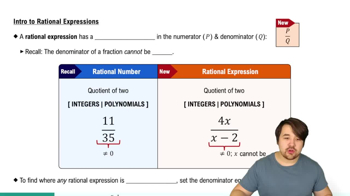
    A fraction where both the numerator and denominator are polynomials, similar to rational numbers but with variables.
  • Numerator

    The top part of a fraction or rational expression, representing the dividend in the division.
  • Denominator

    The bottom part of a fraction or rational expression, representing the divisor and must not be zero.
  • Polynomial

    An algebraic expression made up of terms consisting of numbers and variables combined by addition, subtraction, or multiplication.
  • Factor

    A number or expression that divides another exactly, used to break down polynomials for simplification.
  • Common Factor

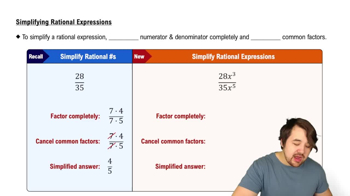
    A shared number or expression in both the numerator and denominator that can be canceled to simplify.
  • Undefined Expression

    A rational expression where the denominator equals zero, making the value impossible to determine.
  • Lowest Terms

    A form of a rational expression where all common factors have been canceled, leaving the simplest version.
  • Greatest Common Factor

    The largest factor shared by all terms in a polynomial, useful for factoring and simplifying.
  • Conjugate

    A pair of expressions in the form a+b and a−b, which are not opposites but differ only in the sign between terms.
  • Opposite Factors

    Expressions where every term has the opposite sign, such as x−a and a−x, resulting in a simplification to negative one.
  • Prime Factorization

    Breaking down a number or expression into its smallest possible factors, often used before canceling.
  • Variable

    A symbol, usually a letter, representing an unknown value in algebraic expressions.
  • Coefficient

    A numerical factor multiplied by a variable in a term of a polynomial.
  • Fraction

    A numerical expression representing division, used as a model for rational expressions in algebra.