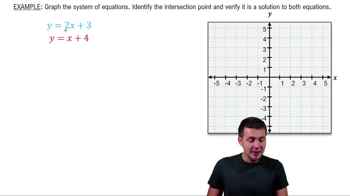
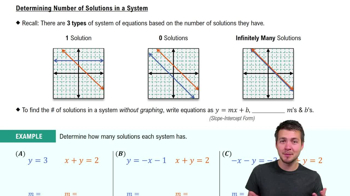
A system of linear equations is a set of two or more linear equations that are considered together, and the solution is the coordinate pair(s) that satisfy all equations simultaneously.
How do you find the solution to a system of equations by graphing?
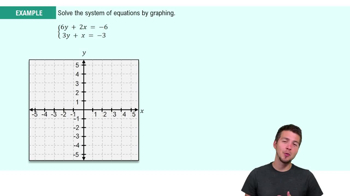
You graph both equations on the same coordinate plane and identify the point where the lines intersect; this intersection point is the solution.
What does it mean if a point lies on both lines in a system of equations?
It means the point is a solution to the system because it satisfies both equations at the same time.
What is the first step when graphing an equation not in slope-intercept form?
Rewrite the equation in slope-intercept form (y = mx + b) to make it easier to graph.
How can you check if your intersection point is correct after graphing?
Substitute the x and y values of the intersection point into both original equations to verify that both equations are true.
What does it mean if two lines in a system are parallel?
If two lines are parallel, they have the same slope but different y-intercepts, so the system has no solution.
What does it mean if two equations in a system are actually the same line?
If the equations are the same line, every point on the line is a solution, so there are infinitely many solutions.
How do you determine the number of solutions a system has without graphing?
Write both equations in slope-intercept form and compare their slopes and y-intercepts to decide if there is one, none, or infinitely many solutions.
What is a consistent and independent system?
A consistent and independent system has exactly one solution, meaning the lines intersect at one point.
What is a consistent and dependent system?
A consistent and dependent system has infinitely many solutions because the equations represent the same line.
What is an inconsistent system of equations?
An inconsistent system has no solutions because the lines are parallel and never intersect.
What does the slope represent in the equation y = mx + b?
The slope (m) represents the steepness of the line, or how much y changes for each unit increase in x.
What does the y-intercept represent in the equation y = mx + b?
The y-intercept (b) is the point where the line crosses the y-axis.
If two equations have different slopes, how many solutions does the system have?
If the slopes are different, the lines will intersect at exactly one point, so there is one solution.
If two equations have the same slope but different y-intercepts, what does this indicate?
This indicates the lines are parallel and the system has no solution.
 Back
Back


 04:42
04:42