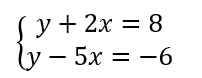
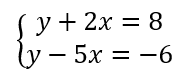
When working with linear equations, a system of equations refers to a set of two or more equations that are considered simultaneously. Unlike solving a single linear equation, where the solution consists of all the coordinate pairs (x, y) that satisfy that one equation, solving a system of linear equations requires finding the coordinate pairs that satisfy every equation in the system at the same time.
For a single linear equation, such as y = 8x - 4, the solution is represented by all points lying on the line defined by that equation. To determine if a point is a solution, you can either substitute the coordinates into the equation to check if it produces a true statement or graph the point to see if it lies on the line.
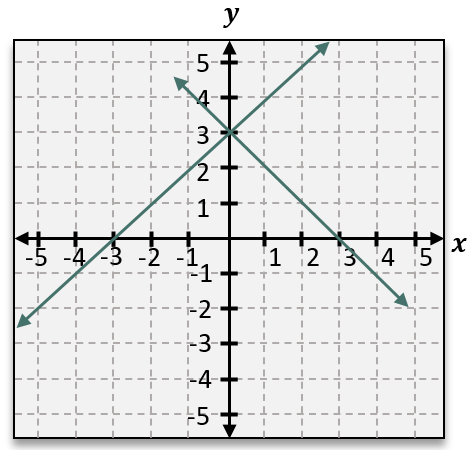
When dealing with a system of linear equations, the solution is the point or points where the graphs of all the equations intersect. This intersection point represents the coordinate pair that satisfies every equation in the system simultaneously. For example, if you have two lines graphed, the solution to the system is the point where these two lines cross. Points that lie on only one of the lines satisfy only one equation and are not solutions to the system.
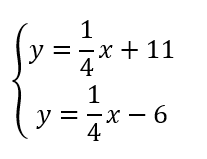
This concept highlights a key difference: a single linear equation has infinitely many solutions along its line, whereas a system of linear equations typically has a unique solution where the lines intersect. However, some systems may have no solution (if the lines are parallel and never intersect) or infinitely many solutions (if the lines coincide).
Understanding systems of linear equations is fundamental in algebra and is essential for solving real-world problems involving multiple constraints. The graphical interpretation provides a visual way to identify solutions, while algebraic methods allow for precise calculation of the intersection points.