Back

Systems of Linear Inequalities definitions

Control buttons has been changed to "navigation" mode.
1/15
  • System of Inequalities

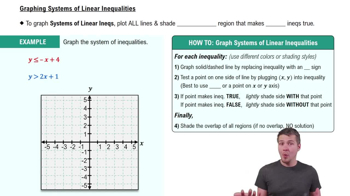
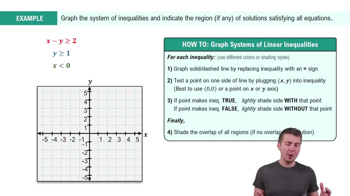
    A collection of two or more inequalities whose solution is the region where all shaded areas overlap on a graph.
  • Boundary Line

    A straight line representing the edge of an inequality's solution region, drawn solid or dashed based on the symbol.
  • Solid Line

    A boundary drawn when the inequality includes equal to, indicating points on the line are part of the solution.
  • Dashed Line

    A boundary drawn when the inequality excludes equal to, showing points on the line are not part of the solution.
  • Slope-Intercept Form

    An equation format y = mx + b, making it easy to identify slope and y-intercept for graphing.
  • Y-Intercept

    The point where a line crosses the y-axis, used as a starting point for graphing.
  • Slope

    A measure of a line's steepness, calculated as rise over run, guiding the direction of the graph.
  • Test Point

    A coordinate, often (0,0), used to check which side of a boundary line satisfies an inequality.
  • Shaded Region

    The area on a graph representing all solutions to an inequality, determined by test points.
  • Overlap

    The intersection of shaded regions from multiple inequalities, indicating the solution to the system.
  • Solution Region

    The part of the graph where all inequalities in a system are satisfied simultaneously.
  • Inequality Symbol

    A sign such as <, >, ≤, or ≥, dictating the boundary style and which region to shade.
  • Coefficient

    A numerical factor multiplying a variable in an equation, affecting slope and direction.
  • Multivariable Polynomial

    An expression involving more than one variable, often used in systems of inequalities.
  • Graphical Representation

    A visual display of equations or inequalities, showing solution regions and overlaps on a coordinate plane.