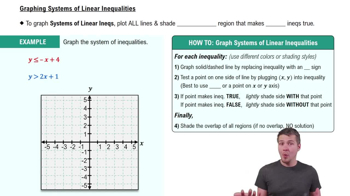
What is the first step when graphing a system of linear inequalities?
The first step is to graph each inequality's boundary line by replacing the inequality symbol with an equal sign.
How do you decide whether to use a solid or dashed line when graphing an inequality?
Use a solid line for ≤ or ≥ and a dashed line for < or >.
What does the overlapping shaded region represent in a system of inequalities?
The overlapping shaded region is the solution set that satisfies all inequalities in the system simultaneously.
How can you determine which side of the boundary line to shade for an inequality?
Use a test point, such as (0,0), and substitute it into the inequality to see if it makes the statement true or false.
What should you do if your test point makes the inequality true?
Shade the side of the line that includes the test point.
What should you do if your test point makes the inequality false?
Shade the side of the line that does not include the test point.
Why is it helpful to use different colors or shading styles when graphing multiple inequalities?
Different colors or shading styles help you clearly see the overlapping solution region.
What is the slope-intercept form of a linear equation?
The slope-intercept form is y = mx + b, where m is the slope and b is the y-intercept.
What does it mean if there is no overlapping region after shading all inequalities?
It means the system of inequalities has no solution.
How do you graph the line for y ≤ -x + 4?
Plot the y-intercept at 4, use a slope of -1, and draw a solid line because the inequality is ≤.
How do you graph the line for y > 2x + 1?
Plot the y-intercept at 1, use a slope of 2, and draw a dashed line because the inequality is >.
What is the purpose of highlighting or outlining the overlapping region after shading?
Highlighting or outlining makes it clear which area is the solution to the system.
Can you use any test point to determine shading, or must it be (0,0)?
You can use any point not on the line, but (0,0) is often the easiest unless it lies on the line.
What do you do if the equations are not in slope-intercept form before graphing?
Rearrange the equations into slope-intercept form (y = mx + b) to make graphing easier.
What is the main difference between solving systems of equations and systems of inequalities?
Systems of equations are solved algebraically or graphically by finding intersection points, while systems of inequalities are solved by graphing and finding overlapping shaded regions.