Back

The Distributive Property definitions

Control buttons has been changed to "navigation" mode.
1/15
  • Distributive Property

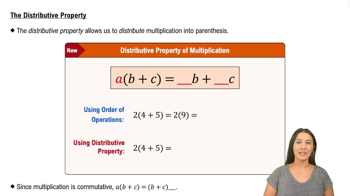
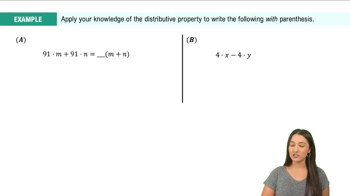
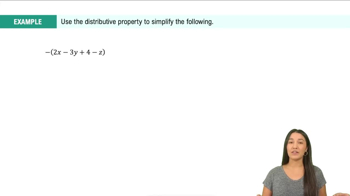
    Connects multiplication with addition or subtraction, enabling expansion of expressions by multiplying each term inside parentheses.
  • Parentheses

    Symbols used to group terms, indicating which operations should be performed together or distributed over.
  • Variable

    A symbol representing an unknown value, often used in expressions where arithmetic cannot be completed directly.
  • Coefficient

    A numerical factor multiplied by a variable in an algebraic term, affecting the term's value.
  • Constant

    A fixed value in an expression, not affected by variables or operations within the expression.
  • Term

    A single part of an expression, which may include numbers, variables, or both, separated by addition or subtraction.
  • Expression

    A mathematical phrase combining numbers, variables, and operations, often requiring simplification.
  • Addition

    An operation combining two or more values or terms, often enclosed in parentheses for distribution.
  • Subtraction

    An operation removing one value from another, treated as addition of a negative when using distribution.
  • Multiplication

    An operation scaling values or terms, distributed across grouped terms in parentheses.
  • Order of Operations

    A set of rules determining the sequence in which calculations are performed in expressions.
  • Expansion

    The process of rewriting an expression by distributing multiplication over grouped terms, eliminating parentheses.
  • Standard Form

    An arrangement of a polynomial where terms are written in a specific order, often after expansion.
  • Polynomial

    An expression consisting of multiple terms, including variables and coefficients, often simplified using distribution.
  • Commutative Property

    A principle stating that the order of multiplication does not affect the result, allowing flexibility in distribution.