Back

The Distributive Property quiz

Control buttons has been changed to "navigation" mode.
1/15
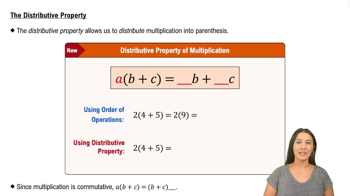
  • What does the distributive property allow you to do with multiplication and parentheses?

    It allows you to distribute multiplication over each term inside the parentheses.
  • How is the distributive property written for addition inside parentheses?

    It is written as a(b + c) = ab + ac.
  • How does the distributive property apply to subtraction inside parentheses?

    It is written as a(b - c) = ab - ac.
  • Why can't you always perform the addition or subtraction inside parentheses before multiplying?

    Because the terms inside the parentheses may include variables, not just numbers.
  • What is the result of applying the distributive property to 2(4 + 5)?

    It becomes 2×4 + 2×5, which simplifies to 8 + 10 = 18.
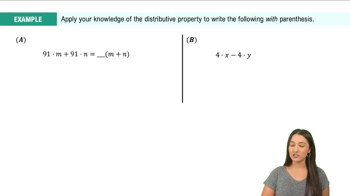
  • How do you use the distributive property to simplify 4(x - 8)?

    You write it as 4×x - 4×8, which simplifies to 4x - 32.
  • Does the distributive property work if the constant is on the right side of the parentheses?

    Yes, because multiplication is commutative, so the order does not matter.
  • How do you expand 3(4x + 2y - 7z) using the distributive property?

    You multiply 3 by each term: 3×4x + 3×2y - 3×7z, which is 12x + 6y - 21z.
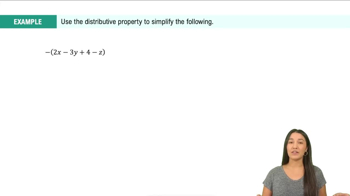
  • What should you pay attention to when distributing over subtraction?

    You must keep the subtraction sign and distribute the multiplier to both terms.
  • Can the distributive property be used with more than two terms inside the parentheses?

    Yes, you distribute the multiplier to each term inside the parentheses.
  • What is the simplified form of 3(4x + 2y - 7z)?

    It is 12x + 6y - 21z.
  • Why is the distributive property important for simplifying polynomials?

    It allows you to expand and combine like terms, especially when variables are involved.
  • What does it mean to 'write an expression without parentheses' using the distributive property?

    It means to expand the expression so that all terms are outside the parentheses.
  • How does the distributive property prepare you for working with exponents and coefficients?

    It helps you understand how to manipulate and expand expressions with variables and numbers.
  • What is the general form of the distributive property for any number of terms inside the parentheses?

    a(b + c + d + ...) = ab + ac + ad + ... for all terms inside the parentheses.