Skip to main content
Beginning & Intermediate Algebra
My Course
Learn
Exam Prep
AI Tutor
Study Guides
Flashcards
Explore
Try the app
My Course
Learn
Exam Prep
AI Tutor
Study Guides
Flashcards
Explore
Try the app
Back
The Square Root Property quiz
You can tap to flip the card.
What is the square root property used for when solving quadratic equations?
You can tap to flip the card.
👆
What is the square root property used for when solving quadratic equations?
It is used to solve equations where a squared term is isolated by taking the square root of both sides, yielding both positive and negative solutions.
Track progress
Control buttons has been changed to "navigation" mode.
1/15
Related flashcards
Related practice
Recommended videos
The Square Root Property definitions
The Square Root Property
15 Terms
The Square Root Property
12. Quadratic Equations and Functions
5 problems
Topic
AllySteele
Completing the Square
12. Quadratic Equations and Functions
5 problems
Topic
AllySteele
12. Quadratic Equations and Functions
4 topics
12 problems
Chapter
ErnestBlazevic
02:26
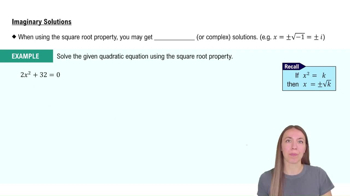
Imaginary Solutions
152
views
05:34
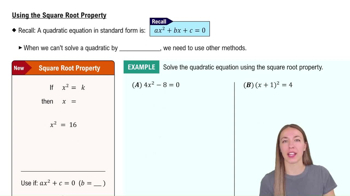
Using The Square Root Property
210
views
5
rank
03:56
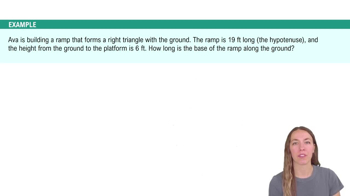
Using The Square Root Property Example 3
129
views
Terms in this set (15)
Hide definitions
What is the square root property used for when solving quadratic equations?
It is used to solve equations where a squared term is isolated by taking the square root of both sides, yielding both positive and negative solutions.
If x² = 16, what are the solutions for x using the square root property?
x = 4 and x = -4.
Why do we include both positive and negative roots when solving x² = k?
Because both (positive root)² and (negative root)² equal k.
What should you do first when solving 4x² - 8 = 0 using the square root property?
Add 8 to both sides to isolate the squared term.
After isolating x² = 2, what are the solutions for x?
x = √2 and x = -√2.
How do you solve (x + 1)² = 4 using the square root property?
Take the square root of both sides to get x + 1 = ±2, then solve for x.
What are the final solutions for x in the equation (x + 1)² = 4?
x = 1 and x = -3.
When can you use the square root property to solve a quadratic equation?
When a squared term is isolated and set equal to a constant.
What happens if you get a negative number under the square root when using the square root property?
The solutions are imaginary and involve the imaginary unit i.
How do you simplify √(-16)?
Rewrite it as √16 × √(-1), which is 4i.
What are the solutions to x² = -16?
x = 4i and x = -4i.
Why is it important to check your solutions by plugging them back into the original equation?
To verify that the solutions make the original equation true.
What type of quadratic equations is the square root property especially useful for?
Equations missing the linear (bx) term or those written as a binomial squared.
What is the imaginary unit i defined as?
i is defined as the square root of -1.
What is the first step in solving 2x² + 32 = 0 using the square root property?
Subtract 32 from both sides to begin isolating the squared term.
 BackBack

 02:26
02:26