Back

Alpha Helix Hydrogen Bonding definitions

Control buttons has been changed to "navigation" mode.
1/14
  • Alpha Helix

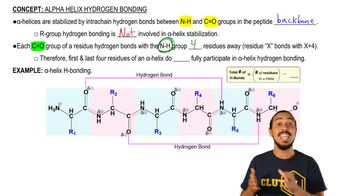
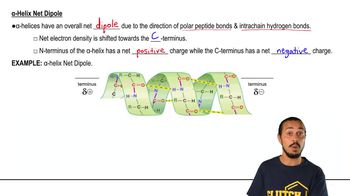
    A right-handed secondary structure stabilized by hydrogen bonds within a single polypeptide chain, featuring a unique net dipole.
  • Hydrogen Bond

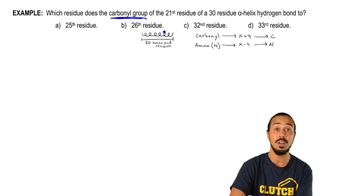
    A stabilizing interaction between backbone carbonyl and amino groups, spaced four residues apart in a polypeptide.
  • Polypeptide Chain

    A linear sequence of amino acids linked by peptide bonds, forming the backbone for secondary structures.
  • Carbonyl Group

    A backbone component in amino acids that forms hydrogen bonds with amino groups four residues away in alpha helices.
  • Amino Group

    A backbone component in amino acids that accepts hydrogen bonds from carbonyl groups four residues away.
  • Residue

    An individual amino acid unit within a polypeptide, crucial for hydrogen bonding patterns in secondary structures.
  • Peptide Bond

    A covalent linkage between amino acids, whose orientation in alpha helices creates a net dipole.
  • R Group

    A side chain of an amino acid, not involved in alpha helix hydrogen bonding but helps identify residue count.
  • C-Terminus

    The end of a polypeptide with a free carboxylate group, accumulating net negative charge in alpha helices.
  • N-Terminus

    The end of a polypeptide with a free amino group, accumulating net positive charge in alpha helices.
  • Net Dipole

    A directional charge separation in alpha helices, resulting from aligned peptide bonds and hydrogen bonding.
  • Secondary Structure

    A local folding pattern in proteins, such as alpha helices and beta sheets, stabilized by backbone hydrogen bonds.
  • Hexapeptide

    A peptide consisting of six amino acid residues, used to illustrate hydrogen bond limitations in alpha helices.
  • Beta Sheet

    A secondary structure with different hydrogen bonding patterns and lacking the net dipole seen in alpha helices.