Back

Atypical Ramachandran Plots definitions

Control buttons has been changed to "navigation" mode.
1/15
  • Ramachandran Plot

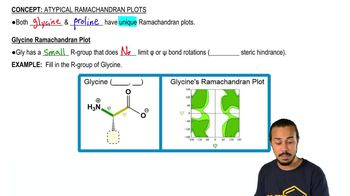
    Graphical representation of permissible phi and psi bond angles in amino acids, highlighting steric constraints and structural flexibility.
  • Glycine

    Amino acid with the smallest R group, allowing extensive bond angle flexibility and minimal steric hindrance in protein structures.
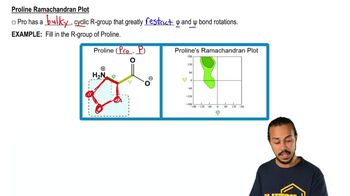
  • Proline

    Amino acid with a bulky cyclic R group, causing significant restriction in bond angle flexibility and unique structural properties.
  • R Group

    Side chain attached to the alpha carbon of an amino acid, determining its chemical properties and steric effects.
  • Steric Hindrance

    Physical limitation caused by bulky groups, restricting permissible bond angles and conformational freedom in molecules.
  • Phi Angle

    Bond angle between the nitrogen and alpha carbon in the peptide backbone, crucial for protein folding and structure.
  • Psi Angle

    Bond angle between the alpha carbon and carbonyl carbon in the peptide backbone, influencing protein conformation.
  • Polypeptide

    Chain of amino acids linked by peptide bonds, forming the primary structure of proteins.
  • Amino Acid Backbone

    Structural framework of amino acids, consisting of repeating units that support side chain attachment and protein formation.
  • Pentagon Shape

    Structural feature of proline’s R group, forming a five-membered ring that impacts its conformational flexibility.
  • Three-Letter Code

    Standard abbreviation for amino acids, such as GLY for glycine and PRO for proline, used in protein notation.
  • One-Letter Code

    Single-character abbreviation for amino acids, such as G for glycine and P for proline, simplifying sequence representation.
  • Quadrant

    Section of the Ramachandran plot, indicating regions of permissible or non-permissible bond angles for amino acids.
  • Cyclic Structure

    Ring-like configuration in proline’s R group, contributing to its restricted bond angle flexibility.
  • Methylene Group

    CH2 unit present in proline’s R group, forming part of its pentagon-shaped cyclic structure.