Back

Atypical Ramachandran Plots quiz

Control buttons has been changed to "navigation" mode.
1/15
  • Which two amino acids have atypical Ramachandran plots compared to the other 18 amino acids?

    Glycine and proline have atypical Ramachandran plots due to their unique R group structures.
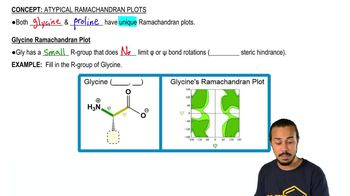
  • Why does glycine have an expansive Ramachandran plot with permissible bond angles in all quadrants?

    Glycine's very small R group causes minimal steric hindrance, allowing its phi and psi bond angles to be permissible in all quadrants.
  • What is the three-letter and one-letter code for glycine?

    Glycine's three-letter code is GLY and its one-letter code is G.
  • How does the R group of glycine affect its ability to fit into protein structures?

    Glycine's small R group allows it to fit into small spaces in proteins that other amino acids cannot.
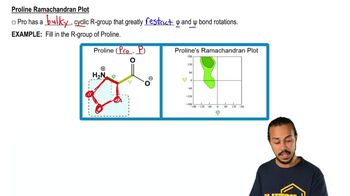
  • What is the main structural feature of proline's R group?

    Proline's R group is bulky, cyclic, and forms a pentagon shape by connecting back to the nitrogen atom.
  • How does proline's R group affect its Ramachandran plot?

    Proline's bulky cyclic R group greatly restricts its phi and psi bond rotations, limiting permissible angles mainly to the upper left quadrant.
  • What are the three-letter and one-letter codes for proline?

    Proline's three-letter code is PRO and its one-letter code is P.
  • How does the structure of proline's R group differ from other amino acids?

    Proline's R group forms a loop that connects back to the backbone nitrogen, making it cyclic and pentagon-shaped.
  • Why does proline have one less hydrogen on its amino group compared to other amino acids?

    Because proline's R group connects back to the nitrogen, the amino group has one less hydrogen.
  • Which amino acid's Ramachandran plot allows permissible bond angles in all four quadrants?

    Glycine's Ramachandran plot allows permissible bond angles in all four quadrants.
  • Which amino acid's Ramachandran plot is mostly restricted to the upper left quadrant?

    Proline's Ramachandran plot is mostly restricted to the upper left quadrant due to its bulky cyclic R group.
  • What causes the non-permissible (white) regions in a typical Ramachandran plot?

    Non-permissible regions are caused by steric hindrance from the R groups of amino acids.
  • How does the Ramachandran plot of glycine differ from that of proline?

    Glycine's plot is expansive with permissible angles in all quadrants, while proline's is highly restricted, mainly to the upper left quadrant.
  • What mnemonic can help you remember the structure of proline's R group?

    Proline's R group resembles the loop of a flipped 'P' and forms a pentagon shape.
  • Why is understanding the unique Ramachandran plots of glycine and proline important?

    Their unique plots help explain their special roles and behaviors in polypeptides and protein structure.