Back

Biological Membranes definitions

Control buttons has been changed to "navigation" mode.
1/15
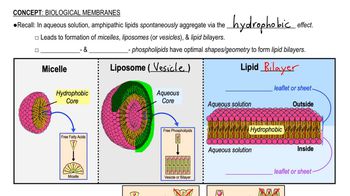
  • Lipid Bilayer

    Structure composed of two sheets of lipids, forming the fundamental framework of cellular membranes and organelles.
  • Phospholipid

    Molecule with a hydrophilic head and hydrophobic tail, forming the main component of biological membranes.
  • Micelle

    Spherical aggregate of lipids with a monolayer, creating a hydrophobic core suitable for free fatty acids.
  • Liposome

    Small vesicle with a lipid bilayer and an aqueous core, often used to encapsulate molecules.
  • Vesicle

    Membrane-bound structure with a lipid bilayer, typically enclosing a small aqueous volume.
  • Hydrophobic Effect

    Phenomenon driving antipathic lipids to aggregate in aqueous environments, crucial for membrane formation.
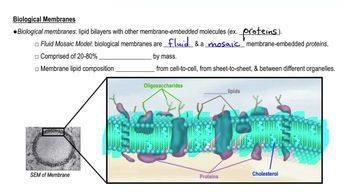
  • Fluid Mosaic Model

    Concept describing membranes as dynamic structures with freely moving lipids and proteins, creating a mosaic appearance.
  • Protein Content

    Proportion of proteins embedded in membranes, ranging from 20% to 80% by mass, influencing membrane function.
  • Extracellular Leaflet

    Outer sheet of the lipid bilayer, facing the external environment of the cell.
  • Intracellular Leaflet

    Inner sheet of the lipid bilayer, oriented toward the cell's interior.
  • Glycerophospholipid

    Type of phospholipid with a glycerol backbone, optimal for forming bilayers and vesicles.
  • Sphingophospholipid

    Phospholipid variant with a sphingosine backbone, contributing to membrane structure.
  • Membrane Composition

    Variety of lipids and proteins present in a membrane, differing across cells, sheets, and organelles.
  • Scanning Electron Micrograph

    Imaging technique providing detailed visualization of membrane structure at high magnification.
  • Organelles

    Cellular compartments surrounded by membranes, each with distinct lipid and protein composition.