Skip to main content
Biochemistry
My Course
Learn
Exam Prep
AI Tutor
Study Guides
Flashcards
Explore
Try the app
My Course
Learn
Exam Prep
AI Tutor
Study Guides
Flashcards
Explore
Try the app
Back
Titration quiz
You can tap to flip the card.
What is the primary purpose of a titration in biochemistry labs?
You can tap to flip the card.
👆
What is the primary purpose of a titration in biochemistry labs?
Titrations are used to measure pH changes and determine the pKa values and concentrations of acids, especially weak acids, in biological systems.
Track progress
Control buttons has been changed to "navigation" mode.
1/15
Related flashcards
Related practice
Recommended videos
Titration definitions
Titration
15 Terms
Titration
2. Water
7 problems
Topic
Buffer Solution
2. Water
7 problems
Topic
2. Water - Part 1 of 3
4 topics
11 problems
Chapter
2. Water - Part 2 of 3
5 topics
11 problems
Chapter
2. Water - Part 3 of 3
4 topics
11 problems
Chapter
Guided course
04:19
Titration of Monoprotic Weak Acids
1414
views
9
rank
2
comments
Guided course
06:33
Titration of Polyprotic Weak Acids
1359
views
13
rank
1
comments
Guided course
07:44
Titration
1894
views
18
rank
1
comments
Terms in this set (15)
Hide definitions
What is the primary purpose of a titration in biochemistry labs?
Titrations are used to measure pH changes and determine the pKa values and concentrations of acids, especially weak acids, in biological systems.
What is the titrant in a titration experiment?
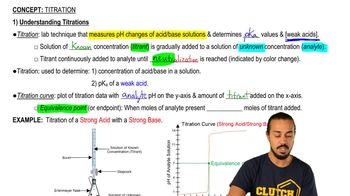
The titrant is the solution of known concentration that is gradually added to the analyte solution during a titration.
What is the analyte in a titration experiment?
The analyte is the solution of unknown concentration being analyzed in a titration.
How is the equivalence point visually indicated during a titration?
The equivalence point is indicated by a color change in the solution, signaling that neutralization has occurred.
What happens at the equivalence point in a titration?
At the equivalence point, the moles of titrant added are exactly equal to the moles of analyte present.
What is plotted on the axes of a titration curve?
The y-axis shows the pH of the analyte solution, and the x-axis shows the amount of titrant added.
What is the pH at the equivalence point for a strong acid-strong base titration?
The equivalence point for a strong acid-strong base titration occurs at pH 7.
How can you identify a strong acid-strong base titration from its titration curve?
The curve starts with a very low pH, rises sharply, and the equivalence point is at pH 7.
What is the inflection point (midpoint) on a titration curve of a weak acid?
The inflection point is where half of the acid is neutralized, and the pH equals the pKa of the weak acid.
What is true about the equivalence point pH in a weak acid-strong base titration?
The equivalence point pH is above 7, typically corresponding to the pKa of the weak acid.
What does the inflection point indicate in a polyprotic acid titration?
Each inflection point indicates the pKa value of one of the acidic hydrogens in the polyprotic acid.
How many equivalence points and inflection points does a polyprotic acid with three acidic hydrogens have?
It has three equivalence points and three inflection points, one for each acidic hydrogen.
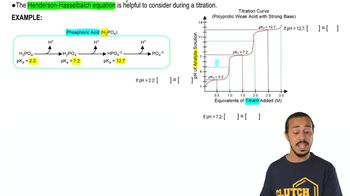
What are the pKa values for the three acidic hydrogens in phosphoric acid (H3PO4)?
The pKa values are 2.2, 7.2, and 12.7 for the three acidic hydrogens in phosphoric acid.
At each inflection point in a polyprotic acid titration, what is true about the concentrations of conjugate acid and base?
At each inflection point, the concentration of conjugate acid equals the concentration of conjugate base.
What happens at the first equivalence point in the titration of phosphoric acid?
At the first equivalence point, H3PO4 is completely neutralized and H2PO4- is at its maximum concentration.
 BackBack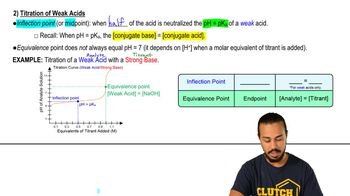
 04:19
04:19