Back

Calculating Vmax definitions

Control buttons has been changed to "navigation" mode.
1/14
  • Vmax

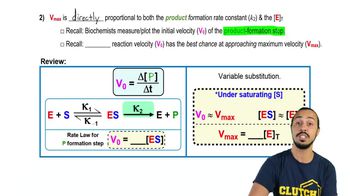
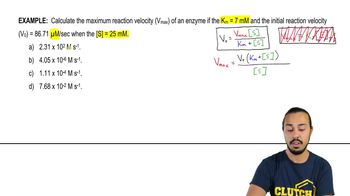
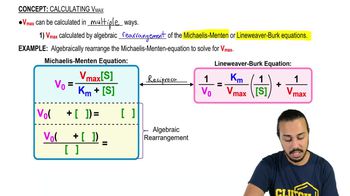
    Theoretical maximal velocity of an enzyme-catalyzed reaction, reached under saturating substrate conditions.
  • Michaelis Menten Equation

    Mathematical expression relating initial reaction velocity to substrate concentration and enzyme kinetics.
  • Lineweaver Burk Equation

    Reciprocal form of the Michaelis Menten equation, used for linearizing enzyme kinetic data.
  • Algebraic Rearrangement

    Process of manipulating equations to isolate desired variables, such as maximal reaction velocity.
  • Rate Law

    Equation describing the relationship between reaction velocity and concentrations of reactants or complexes.
  • Product Formation Rate Constant

    Kinetic parameter, often denoted k2, representing the speed at which product is generated in an enzyme reaction.
  • Total Enzyme Concentration

    Sum of all enzyme molecules present, crucial for determining maximal reaction velocity.
  • Initial Reaction Velocity

    Rate at which product forms at the start of an enzyme-catalyzed reaction, before substrate depletion.
  • Enzyme Substrate Complex

    Intermediate formed when enzyme binds substrate, central to rate law calculations.
  • Saturating Substrate Concentration

    Condition where substrate is abundant enough that all enzyme molecules are bound, maximizing reaction rate.
  • Reciprocal Relationship

    Mathematical connection where one equation is the inverse of another, as seen between Michaelis Menten and Lineweaver Burk.
  • Variable Substitution

    Technique of replacing one variable with another equivalent under specific conditions, such as v0 with Vmax.
  • Reaction Order

    Exponent indicating how the rate depends on reactant concentration, often unity in simple enzyme reactions.
  • Practice Problems

    Exercises designed to reinforce calculation methods and decision-making in enzyme kinetics.