Back

Calculating Vmax quiz

Control buttons has been changed to "navigation" mode.
1/15
  • What are the two primary methods for calculating Vmax?

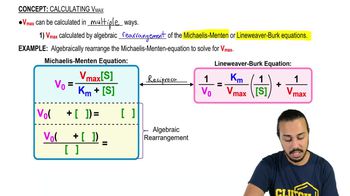
    Vmax can be calculated by algebraic rearrangement of the Michaelis Menten or Lineweaver Burk equations, and by using the rate law for product formation.
  • How are the Michaelis Menten and Lineweaver Burk equations related?

    The Lineweaver Burk equation is the reciprocal of the Michaelis Menten equation, allowing easy interconversion between them.
  • What is the first step in isolating Vmax in the Michaelis Menten equation?

    The denominator (Km + [S]) is moved to the other side by multiplying both sides by it.
  • After moving the denominator, what is the next step to isolate Vmax?

    Divide both sides by the substrate concentration ([S]) to solve for Vmax.
  • What is the algebraic expression for Vmax after rearranging the Michaelis Menten equation?

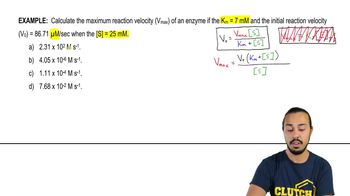
    Vmax = v0(Km + [S])/[S], where v0 is the initial reaction velocity.
  • What does Vmax represent in enzyme kinetics?

    Vmax is the theoretical maximal reaction velocity of an enzyme-catalyzed reaction.
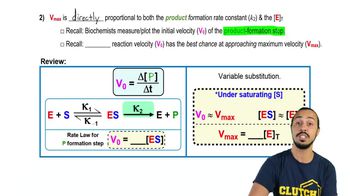
  • What is Vmax directly proportional to in the rate law method?

    Vmax is directly proportional to the product formation rate constant (k2) and the total enzyme concentration.
  • What is the initial reaction velocity (v0) in terms of product concentration?

    v0 is expressed as the change in product concentration over time (Δ[P]/Δt).
  • Why do biochemists focus on measuring the initial reaction velocity?

    Because the initial reaction velocity best approaches the theoretical maximal velocity (Vmax) and reflects the product formation step.
  • Which rate constant is relevant for the product formation step in enzyme catalysis?

    The rate constant k2 is relevant for the product formation step.
  • What is the rate law for the product formation step in enzyme catalysis?

    The rate law is v0 = k2 × [ES], where [ES] is the concentration of the enzyme-substrate complex.
  • Under saturating substrate conditions, what can [ES] be approximated as?

    Under saturating substrate conditions, [ES] can be approximated as the total enzyme concentration ([E]total).
  • How is Vmax expressed using the rate law under saturating substrate conditions?

    Vmax = k2 × [E]total, where [E]total is the total enzyme concentration.
  • What variable substitution is made in the rate law under saturating substrate conditions?

    The initial reaction velocity (v0) is substituted with Vmax in the rate law.
  • What decision must be made when solving practice problems for Vmax?

    You must identify which of the two methods—algebraic rearrangement or rate law—is appropriate for calculating Vmax.