Back

Covalent Catalysis quiz

Control buttons has been changed to "navigation" mode.
1/15
  • What is covalent catalysis in enzyme reactions?

    Covalent catalysis involves a transient covalent bond forming between the enzyme and substrate, creating an intermediate molecule.
  • How does covalent catalysis affect the reaction rate compared to uncatalyzed reactions?

    Covalent catalysis increases the reaction rate overall, even though it introduces an extra intermediate and a longer pathway.
  • What type of amino acids do enzymes use in covalent catalysis?

    Enzymes use nucleophilic amino acids, which have extra electron density to donate, in covalent catalysis.
  • What do nucleophilic amino acids attack during covalent catalysis?

    Nucleophilic amino acids attack electrophilic centers in substrates, which have less electron density.
  • Why must covalent bonds formed between enzyme and substrate be broken?

    The covalent bonds must be broken to restore the original enzyme, since enzymes are not consumed in the reaction.
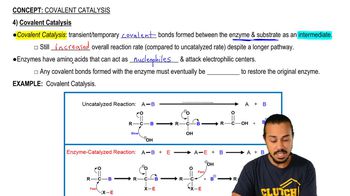
  • What is the main difference between uncatalyzed and enzyme-catalyzed hydrolysis reactions shown in the example?

    The enzyme-catalyzed reaction involves the enzyme forming a temporary covalent bond with the substrate, while the uncatalyzed reaction does not.
  • What is the role of the enzyme in the catalyzed hydrolysis reaction example?

    The enzyme acts as a nucleophile, attacking the carbonyl group of the substrate to facilitate the reaction.
  • Does the enzyme get consumed during covalent catalysis?

    No, the enzyme is not consumed; it is restored after the covalent bond is broken.
  • What is an intermediate molecule in covalent catalysis?

    An intermediate molecule is a temporary product formed when the enzyme and substrate are covalently bonded during the reaction.
  • What is an example of an enzyme that utilizes covalent catalysis?

    Chymotrypsin is an example of an enzyme that uses covalent catalysis.
  • What is the function of nucleophiles in covalent catalysis?

    Nucleophiles donate electron density to attack electrophilic centers in substrates, forming a covalent bond.
  • What happens to the substrate in the uncatalyzed hydrolysis reaction?

    The substrate, initially with components A and B covalently attached, is converted into products where A and B are no longer covalently attached.
  • How does the enzyme-catalyzed reaction compare to the uncatalyzed reaction in terms of products?

    Both reactions produce the same products, but the enzyme-catalyzed reaction is faster due to covalent catalysis.
  • What is the significance of the additional step in enzyme-catalyzed covalent catalysis?

    The additional step involves forming and breaking a covalent bond with the enzyme, but the overall reaction is still faster.
  • What must happen for the enzyme to be ready for another catalytic cycle after covalent catalysis?

    The covalent bond between the enzyme and substrate must be broken, restoring the enzyme to its original state.