Back

Diagonal Electrophoresis quiz

Control buttons has been changed to "navigation" mode.
1/15
  • What is the main purpose of diagonal electrophoresis in protein analysis?

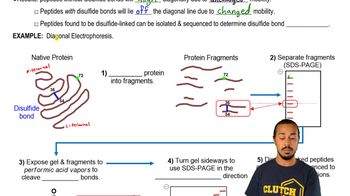
    Diagonal electrophoresis is used to isolate and identify disulfide-linked proteins and determine the positions of original disulfide bonds.
  • What type of bond does diagonal electrophoresis help to identify in proteins?

    It helps to identify disulfide bonds, which are covalent bonds between cysteine residues.
  • What happens to peptides without disulfide bonds during diagonal electrophoresis?

    Peptides without disulfide bonds align diagonally on the gel due to unchanged mobility between the two electrophoresis steps.
  • How do peptides with disulfide bonds appear in diagonal electrophoresis results?

    Peptides with disulfide bonds lie off the diagonal line because their mobility changes after disulfide bond cleavage.
  • What is the first step in diagonal electrophoresis?

    The first step is to fragment the protein into smaller peptide fragments using enzymes or chemicals.
  • What technique is used to separate protein fragments in diagonal electrophoresis?

    SDS–PAGE is used to separate protein fragments based on their molecular size.
  • What chemical is used to cleave disulfide bonds in diagonal electrophoresis?

    Performic acid is used to cleave disulfide bonds in the protein fragments.
  • What is done after exposing the gel to performic acid in diagonal electrophoresis?

    The gel is turned sideways and SDS–PAGE is run a second time in a perpendicular direction.
  • Why do peptides align diagonally in the second SDS–PAGE run?

    Peptides align diagonally because their mobility remains unchanged between the first and second gel runs.
  • What does it indicate if a protein band lies off the diagonal line in diagonal electrophoresis?

    It indicates that the protein fragment is disulfide-linked.
  • What is the final step in diagonal electrophoresis after identifying disulfide-linked peptides?

    The disulfide-linked peptides are isolated and sequenced to determine the positions of the disulfide bonds.
  • How does diagonal electrophoresis distinguish between interchain and intrachain disulfide bonds?

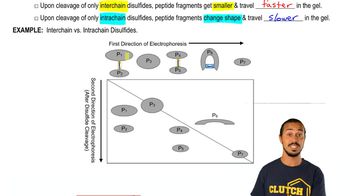
    Interchain disulfide bonds result in fragments migrating faster and appearing below the diagonal, while intrachain disulfide bonds cause fragments to migrate slower and appear above the diagonal.
  • What happens to peptide fragments with interchain disulfide bonds after performic acid treatment?

    They become smaller and travel faster in the gel, appearing below the diagonal line.
  • What happens to peptide fragments with intrachain disulfide bonds after performic acid treatment?

    They change shape and travel slower in the gel, appearing above the diagonal line.
  • Why is diagonal electrophoresis important for understanding protein structure?

    It reveals the positions of cysteine bonds, which are crucial for understanding protein conformation and quaternary structure.