Back

Edman Degradation Sequenator and Sequencing Data Analysis definitions

Control buttons has been changed to "navigation" mode.
1/15
  • Edman Degradation

    Automated method for sequencing proteins by removing and identifying amino acids from the N-terminal end.
  • Sequenator

    Instrument that automates reagent mixing, product separation, and data recording for protein sequencing.
  • PTH Amino Acid

    Final product of Edman degradation, used for identification in sequencing via chromatographic analysis.
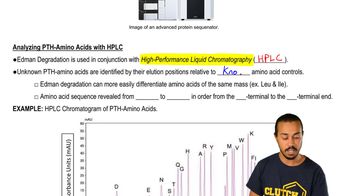
  • High-Performance Liquid Chromatography

    Technique that separates and identifies PTH amino acids by comparing elution positions to known controls.
  • Chromatogram

    Graphical output displaying absorbance versus elution time, revealing peptide sequence order.
  • Elution Time

    Duration required for an amino acid to exit the chromatography column, used for identification.
  • Absorbance

    Measurement on the chromatogram's y-axis indicating the presence and quantity of amino acids.
  • N-terminal

    Starting end of a peptide sequence, where Edman degradation begins and sequencing is read left to right.
  • C-terminal

    Ending end of a peptide sequence, reached last in Edman degradation sequencing.
  • Mass Spectrometry

    Analytical technique that reads peptide sequences from right to left but struggles with isomer differentiation.
  • Isomer

    Molecule with identical mass and chemical formula as another, such as Leucine and Isoleucine.
  • Amino Acid Control

    Reference sample with known elution position used to identify unknown PTH amino acids in HPLC.
  • Peptide Sequence

    Order of amino acids in a protein, revealed by chromatogram peaks from N-terminal to C-terminal.
  • Nanogram

    Extremely small mass unit, indicating the sensitivity of detection in Edman degradation.
  • Picomole

    Tiny amount of substance, demonstrating the minimal quantity detectable by the sequenator.