Back

Edman Degradation Sequenator and Sequencing Data Analysis quiz

Control buttons has been changed to "navigation" mode.
1/15
  • What is the main function of the Edman degradation sequenator?

    It automates the process of sequencing proteins by mixing reagents, identifying products, and recording data.
  • Which reagents does the Edman degradation sequenator mix during protein sequencing?

    It mixes PITC (phenylisothiocyanate), trifluoroacetic acid, and aqueous acid.
  • How sensitive is the Edman degradation sequenator in detecting amino acids?

    It can detect as little as 1 nanogram or 10 picomoles of an amino acid.
  • What are the final products of the Edman degradation cycle?

    The final products are PTH (phenylthiohydantoin) amino acids.
  • Which analytical technique is used to identify PTH amino acids after Edman degradation?

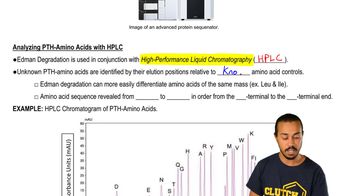
    High-Performance Liquid Chromatography (HPLC) is used to identify PTH amino acids.
  • How does HPLC identify unknown PTH amino acids?

    HPLC compares the elution positions of unknown PTH amino acids to those of known amino acid controls.
  • Why does mass spectrometry struggle to differentiate between leucine and isoleucine?

    Because leucine and isoleucine are isomers with the same chemical formula and mass.
  • What advantage does Edman degradation have over mass spectrometry in sequencing?

    Edman degradation can more easily distinguish between isomeric amino acids like leucine and isoleucine.
  • In an HPLC chromatogram, in which direction is the peptide sequence revealed?

    The sequence is revealed from left to right, corresponding to the N-terminal to C-terminal direction.
  • What does the y-axis represent in an HPLC chromatogram?

    The y-axis represents absorbance, typically in units of milliabsorbance.
  • What does the x-axis represent in an HPLC chromatogram?

    The x-axis represents elution time in minutes.
  • How do you determine the sequence of a peptide from an HPLC chromatogram?

    You read the peaks from left to right, with each peak corresponding to an amino acid from the N-terminal to the C-terminal.
  • How does the reading direction of HPLC chromatograms differ from mass spectrometry spectra?

    HPLC chromatograms are read left to right (N- to C-terminus), while mass spectrometry spectra are read right to left.
  • What is the significance of matching elution positions in HPLC analysis?

    Matching elution positions allows identification of unknown PTH amino acids by comparison to known standards.
  • Why is the Edman degradation sequenator considered an advanced instrument?

    Because it automates reagent mixing, product separation, identification, and data recording for protein sequencing.