What happens to the enzyme after a reaction is catalyzed?
The enzyme is released unaltered and is not consumed by the reaction, allowing it to catalyze additional reactions.
Where does the substrate bind to the enzyme?
The substrate binds to the active site of the enzyme.
What is the substrate of the enzyme amylase?
The substrate of the enzyme amylase is starch.
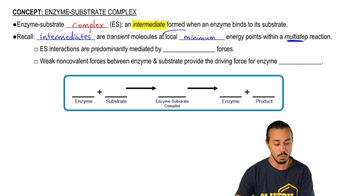
What does the abbreviation 'ES' stand for in enzyme kinetics?
The abbreviation 'ES' stands for enzyme-substrate complex. It represents the intermediate formed when an enzyme binds to its substrate.
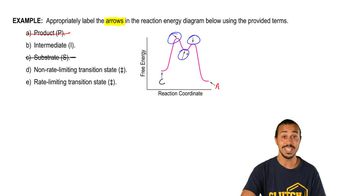
Where do intermediates appear on an energy diagram during a multi-step reaction?
Intermediates appear at local minimum energy points on an energy diagram. They are transient molecules that do not last long before reacting again.
What type of forces predominantly mediate the formation of the enzyme-substrate complex?
The formation of the enzyme-substrate complex is predominantly mediated by non-covalent forces. Examples include hydrogen bonds and ionic bonds.
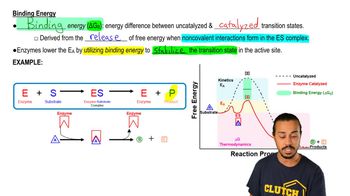
How is binding energy symbolized in enzyme catalysis diagrams?
Binding energy is symbolized as delta G_b (ΔG_b) in enzyme catalysis diagrams. It represents the energy difference between uncatalyzed and catalyzed transition states.
Why is the enzyme-substrate complex often not shown in most energy diagrams?
The enzyme-substrate complex is often not shown because it is a transient intermediate that does not last long. Most diagrams focus on the transition states rather than intermediates.
What is the main way enzymes lower the activation energy of a reaction?
Enzymes lower the activation energy by stabilizing the transition state using binding energy. This allows the reaction to proceed at a faster rate.
What happens to the energy of activation for the formation of the enzyme-substrate complex?
The energy of activation for forming the enzyme-substrate complex is very small. This allows the complex to form readily during the reaction.