Back

FDNB definitions

Control buttons has been changed to "navigation" mode.
1/15
  • FDNB

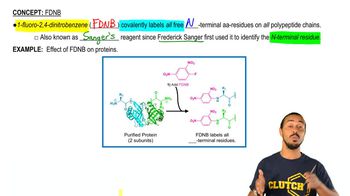
    A reagent that covalently attaches to free N-terminal amino acid residues, enabling identification of protein subunits and structure.
  • Sanger's reagent

    A chemical named after Frederick Sanger, used to label N-terminal residues in polypeptide chains for protein analysis.
  • N-terminal amino acid residue

    The first amino acid in a polypeptide chain, uniquely labeled by FDNB to reveal protein composition and subunit count.
  • Polypeptide chain

    A sequence of amino acids forming part of a protein, each with distinct N- and C-terminal ends.
  • Quaternary structure

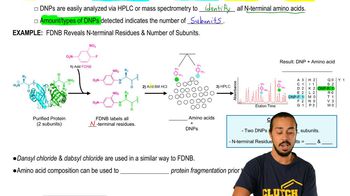
    A protein configuration consisting of multiple subunits, each with its own N-terminal residue.
  • Subunit

    An individual polypeptide within a protein complex, identified by the number of labeled N-terminal residues.
  • C-terminal end

    The terminal amino acid of a polypeptide chain, not reactive with FDNB during protein analysis.
  • Amino acid hydrolysis

    A process using hydrochloric acid to cleave peptide bonds, releasing amino acids for further analysis.
  • Dinitrophenyl derivative

    A modified amino acid formed when FDNB labels N-terminal residues, facilitating detection by analytical methods.
  • DNP

    A product of FDNB labeling, representing N-terminal amino acids as dinitrophenyl derivatives for identification.
  • HPLC

    A chromatographic technique used to separate and identify DNP-labeled amino acids and protein composition.
  • Mass spectrometry

    An analytical method for detecting and characterizing DNP derivatives, revealing protein structure details.
  • Peptide bond

    A chemical linkage between amino acids in a polypeptide, broken during hydrolysis to release individual residues.
  • Amino acid composition

    The specific arrangement and quantity of amino acids in a protein, determined after FDNB treatment and hydrolysis.
  • Protein fragmentation

    A preparatory step for sequencing, informed by amino acid composition and DNP analysis to strategize protein breakdown.