Back

Fetal Hemoglobin definitions

Control buttons has been changed to "navigation" mode.
1/14
  • Fetal Hemoglobin

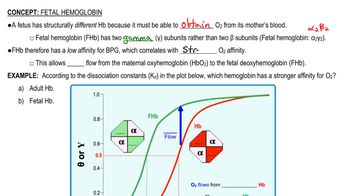
    Protein in the fetus with two alpha and two gamma subunits, enabling efficient oxygen uptake from maternal blood.
  • Adult Hemoglobin

    Protein in adults composed of two alpha and two beta subunits, with lower oxygen affinity compared to its fetal counterpart.
  • Alpha Subunit

    Component present in both fetal and adult hemoglobin, crucial for oxygen binding and structural stability.
  • Gamma Subunit

    Unique component of fetal hemoglobin, replacing beta subunits and contributing to higher oxygen affinity.
  • Beta Subunit

    Component found in adult hemoglobin, absent in fetal hemoglobin, influencing oxygen binding properties.
  • BPG

    Negative heterotrophic allosteric inhibitor that reduces oxygen affinity in hemoglobin, with lower binding in fetal form.
  • Oxygen Affinity

    Measure of how strongly hemoglobin binds oxygen; higher in fetal hemoglobin due to structural differences.
  • Oxygen Saturation Curve

    Graph depicting fractional saturation of hemoglobin versus partial pressure of oxygen, illustrating affinity differences.
  • Dissociation Constant

    Value indicating hemoglobin's tendency to release oxygen; lower values reflect stronger oxygen binding.
  • Maternal Oxyhemoglobin

    Form of hemoglobin in the mother carrying oxygen, serving as the source for fetal oxygen transfer.
  • Fetal Deoxyhemoglobin

    Form of fetal hemoglobin lacking bound oxygen, ready to accept oxygen from maternal blood.
  • Fractional Saturation

    Proportion of hemoglobin molecules bound to oxygen, used to assess oxygen transport efficiency.
  • Partial Pressure of Oxygen

    Measurement of oxygen concentration in blood, influencing hemoglobin's oxygen binding and release.
  • Allosteric Inhibitor

    Molecule that binds hemoglobin at a site other than the active site, altering its oxygen affinity.