Back

G protein-Coupled Receptors definitions

Control buttons has been changed to "navigation" mode.
1/15
  • GPCR

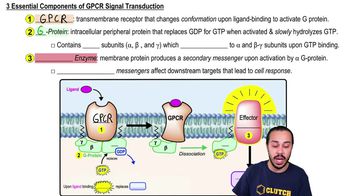
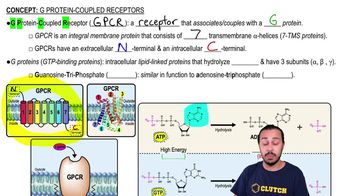
    Integral membrane protein with seven transmembrane alpha helices, mediating extracellular signal transduction via G proteins.
  • Transmembrane Alpha Helix

    Segment of protein spanning the membrane, forming part of the structural core in GPCRs.
  • N-terminal

    Extracellular end of a protein, marking the start of the amino acid sequence in GPCRs.
  • C-terminal

    Intracellular end of a protein, marking the finish of the amino acid sequence in GPCRs.
  • G Protein

    Heterotrimeric, lipid-linked intracellular protein, switching between active and inactive states by binding GTP or GDP.
  • Alpha Subunit

    Component of G protein that dissociates upon activation and interacts with effector enzymes.
  • Beta-Gamma Subunit

    Paired components of G protein remaining together after alpha subunit dissociation.
  • Heterotrimeric Protein

    Protein complex composed of three distinct subunits, as seen in G proteins associated with GPCRs.
  • GTP

    High-energy nucleotide enabling G protein activation, structurally similar to ATP.
  • GDP

    Low-energy nucleotide resulting from GTP hydrolysis, marking the inactive state of G proteins.
  • Effector Enzyme

    Membrane-bound enzyme activated by G protein alpha subunit, responsible for generating secondary messengers.
  • Secondary Messenger

    Intracellular molecule produced by effector enzymes, triggering downstream cellular responses.
  • Stimulatory G Protein

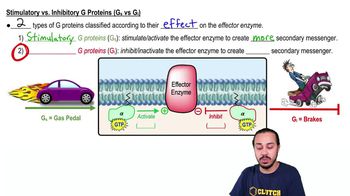
    Type of G protein (Gs) enhancing effector enzyme activity, increasing secondary messenger production.
  • Inhibitory G Protein

    Type of G protein (Gi) reducing effector enzyme activity, decreasing secondary messenger production.
  • Signal Transduction Pathway

    Sequence of molecular events initiated by extracellular signals, resulting in specific cellular responses.